Table of Contents
Few figures from ancient Egypt are as instantly recognizable as Anubis, the mysterious jackal-headed god who stood between the world of the living and the realm of the dead.
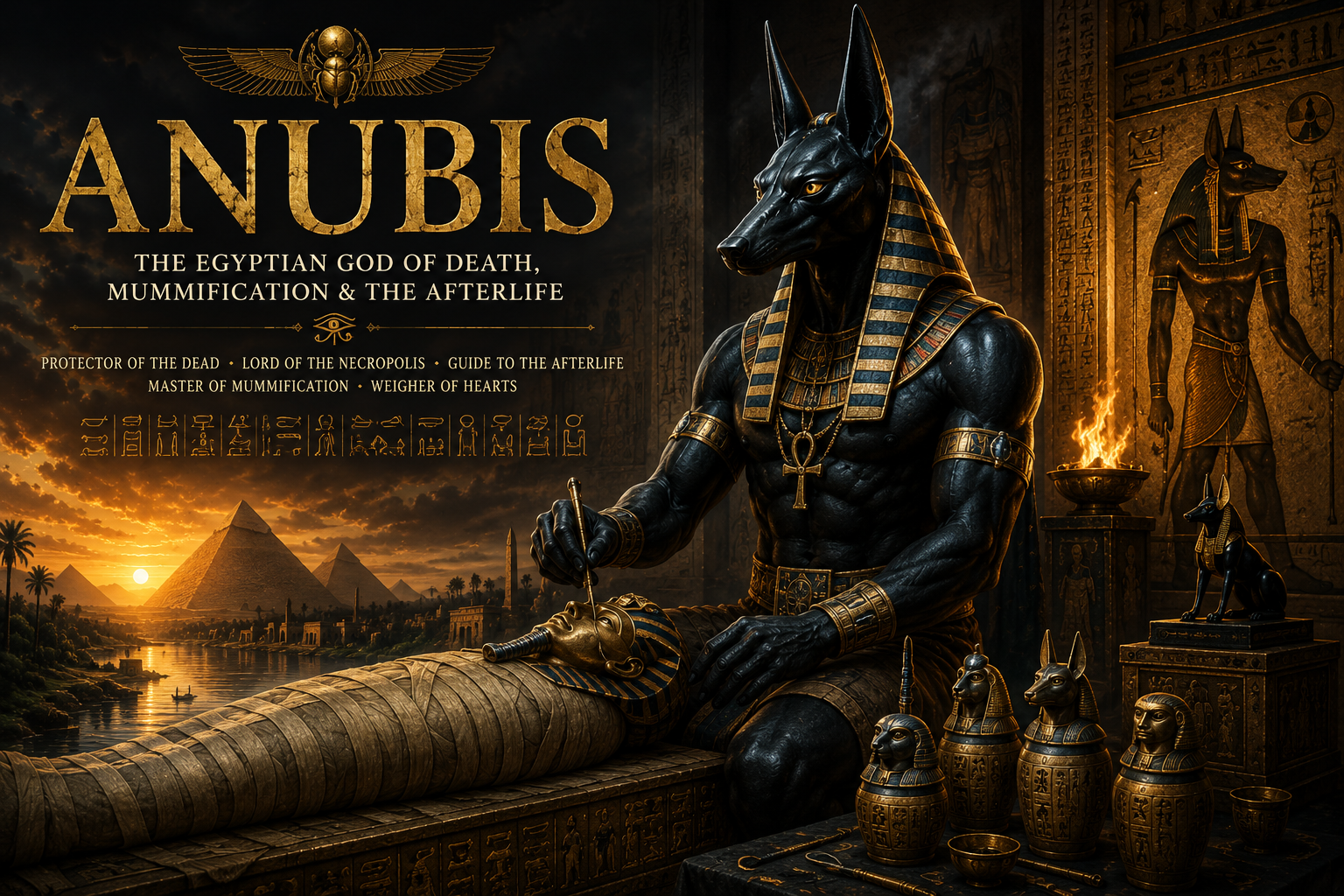
Often depicted as a black jackal or as a human figure with the head of a jackal, Anubis was closely associated with mummification, burial rituals, protection of the dead, and the journey into the afterlife. His dark appearance has made him a popular symbol of death in modern culture, but his ancient Egyptian meaning was much more complex.
Anubis was not simply a “god of death.”
He was a guardian.
He protected the dead, oversaw the embalming process, and played an important role in the judgment of the deceased. The Metropolitan Museum of Art describes Anubis as a jackal-headed god who oversaw embalming and protected the necropolis, while also supervising the weighing of the heart before Osiris.
So who exactly was Anubis, and why did the ancient Egyptians give their god of mummification the form of a jackal?
Who Was Anubis?
Anubis was one of ancient Egypt’s most important funerary gods.
His primary associations included:
- Mummification
- Embalming
- Burial rituals
- Protection of tombs
- Protection of the dead
- The transition into the afterlife
- The judgment of the deceased
The ancient Egyptians represented him either as a recumbent black canid or as a human with a jackal-like head. Museum examples show both forms.
His appearance was not chosen randomly.
Jackals and other wild canids were associated with desert areas and burial grounds. Ancient Egyptians observed these animals around cemeteries and could therefore have understood them as natural guardians of the places where the dead were buried. The Metropolitan Museum specifically notes this connection between jackals and ancient Egyptian burial grounds.
Anubis transformed that observation of nature into religious symbolism.
The animal that appeared near the cemetery became the divine guardian of the cemetery.
Why Does Anubis Have a Jackal Head?
The jackal is perhaps the most important clue to understanding Anubis.
Ancient Egyptian cemeteries were often located on the edge of the desert, where wild canids could be seen.
To people responsible for protecting tombs and preserving bodies, the presence of these animals around burial grounds would have been impossible to ignore.
Rather than simply seeing the jackal as a threat, Egyptian religious thought could transform the animal into a supernatural protector.
This created a powerful symbolic relationship:
The jackal lived near the dead, so Anubis became the guardian of the dead.
This is why Anubis’s animal form is so important to his identity.
The Metropolitan Museum notes that ancient jackals were associated with burial grounds and that Egyptian artists represented Anubis with a jackal’s head.
What Did Anubis Look Like?
Anubis appears in several forms throughout Egyptian art.
The most famous is a human body with the head of a jackal.
He is commonly shown wearing a short kilt or divine garments and standing or kneeling beside the deceased.
He could also appear entirely as a black jackal-like animal.
The black color is particularly significant in Egyptian symbolism.
Black was associated with the fertile soil left behind by the Nile and could therefore carry associations with regeneration and rebirth.
This makes Anubis’s dark appearance more meaningful than simply making him look frightening.
He represents death, but he also belongs to a religious system deeply concerned with renewal and life after death.
Anubis and Mummification
One of Anubis’s most important responsibilities was mummification.
Ancient Egyptians believed that preserving the body was essential to the deceased’s continued existence.
Anubis therefore became closely associated with the specialists and rituals responsible for preparing the body.
The Metropolitan Museum describes him as the god of embalming and protector of mummies.
In Egyptian religious art, Anubis may be shown performing rituals over a mummy.
Some representations also show priests wearing masks resembling Anubis during funerary ceremonies.
The Metropolitan Museum notes that priests performing purification and transformation rites over a mummy could wear jackal masks to impersonate the god.
This demonstrates something important:
Anubis was not merely represented in Egyptian art.
His identity could actually be ritually embodied by priests.
Why Was Mummification Important?
To understand Anubis, we need to understand why Egyptians cared so much about preserving the dead.
Ancient Egyptian beliefs about death were not based simply on the idea that a person disappeared.
The deceased could continue existing in another form.
The body therefore remained important.
Mummification preserved the physical remains while funerary rituals helped prepare the deceased for existence in the afterlife.
Anubis stood at the center of this transition.
He represented the protection of the body and the proper preparation of the deceased for what came next.
Anubis and the Judgment of the Dead
Perhaps the most famous image associated with Anubis is the weighing of the heart.
According to ancient Egyptian funerary traditions, the deceased eventually faced judgment.
Anubis was associated with the weighing of the heart, in which the heart of the deceased was placed on a balance.
The heart was compared with the feather of Ma’at, representing truth, justice, and cosmic order.
If the deceased was found worthy, the journey toward the afterlife could continue.
If not, the deceased faced a terrifying fate involving Ammit, the devourer.
Anubis’s role was therefore not simply to represent death.
He was connected with judgment, order, and the safe transition of the deceased.
The Metropolitan Museum specifically describes Anubis as supervising the weighing of the heart for Osiris.
Anubis and Osiris
Anubis is closely connected with Osiris, the Egyptian god of the dead and the afterlife.
In Egyptian mythology, Osiris became one of the central figures of the realm of the dead.
Anubis, meanwhile, served important funerary and protective functions.
The two gods therefore became closely connected in Egyptian funerary religion.
The British Museum’s educational material identifies Anubis as the god of embalming and the dead, while Osiris is identified as the god of the dead and the afterlife.
This distinction is useful.
Anubis and Osiris are sometimes both casually called “gods of death,” but their roles were not identical.
Anubis was strongly associated with embalming, burial, protection, and the transition of the deceased.
Osiris was the great ruler and deity of the dead and the afterlife.
Understanding this difference makes the mythology much clearer.
Anubis and the Protection of Tombs
Ancient Egyptians invested enormous effort in protecting their dead.
Tombs contained the bodies, possessions, offerings, and religious objects believed to support the deceased.
Anubis became a natural divine guardian for this sacred environment.
The Metropolitan Museum describes him as the protector of the necropolis, or burial ground.
This explains why images of Anubis frequently appear around funerary objects.
He was not there merely to represent death.
He was there to protect the dead from the dangers surrounding their journey.
The Anubis Fetish
One of the more mysterious objects associated with Anubis is the imiut fetish.
The Metropolitan Museum describes the imiut as “the one in the wrappings.” It consisted of an animal skin or animal-shaped form attached to a staff, with early examples placed protectively around sacred spaces and later examples associated with funerary gods and rituals.
The object demonstrates how complicated Egyptian funerary symbolism could be.
Anubis was not represented through one single symbol.
His religious identity could involve:
- Jackals
- Mummies
- Burial grounds
- Embalming equipment
- Protective objects
- Funerary rituals
- The weighing of the heart
Together, these symbols created a complete religious concept surrounding death and rebirth.
Was Anubis Really the Egyptian God of Death?
This is one of the most common questions about Anubis.
The short answer is:
Not exactly.
Calling Anubis the “god of death” is understandable, but it simplifies his role.
Anubis was more specifically associated with mummification, embalming, funerary rites, protection of the dead, and the transition into the afterlife.
The British Museum identifies him as the god of embalming and the dead.
Meanwhile, Osiris played a major role as the god and ruler associated with the dead and the afterlife.
Therefore, describing Anubis as the guardian of the dead or god of mummification is often more precise than simply calling him the god of death.
Anubis and the Underworld
Modern movies and games often portray Anubis as a ruler of a dark underworld.
Ancient Egyptian religion was more complicated.
Anubis was an important figure in the funerary journey, but he was not simply an Egyptian equivalent of a devil or grim reaper.
His role was protective.
He helped guide and safeguard the deceased.
This difference is essential to understanding why ancient Egyptians could portray Anubis as a powerful but reassuring figure.
Death was frightening.
But Anubis represented the possibility that the dead could be protected through the dangerous transition.
Anubis in Ancient Egyptian Art
Artists represented Anubis in many different forms.
One particularly striking example is a recumbent canid statue held by the Metropolitan Museum of Art.
The statue dates to approximately 343–30 BCE, during the Late Period–Ptolemaic transition, and was originally painted black.
Another example is a Ptolemaic-period wooden figure of Anubis performing purification and transformation rituals over a mummy.
These objects show how artists could communicate religious ideas through posture, color, animal form, and ritual imagery.
The lying jackal creates the impression of a guardian watching over a sacred space.
The standing human-jackal figure emphasizes divine action.
Together, these images reveal different aspects of Anubis’s role.
Anubis Amulets
Anubis also appeared on funerary amulets.
The Metropolitan Museum holds examples of Anubis amulets dating from the Late Period to the Ptolemaic Period, roughly 664–30 BCE. These amulets were associated with protection of the deceased.
The use of Anubis as an amulet makes perfect symbolic sense.
If Anubis protected the dead, carrying his image could represent a form of supernatural protection.
His image could therefore become both a religious symbol and a personal protective object.
What Does Anubis Symbolize?
Anubis has several major symbolic meanings.
Protection
Anubis protects the dead and their burial places.
Transformation
He represents the transition from physical death toward the afterlife.
Mummification
He is strongly connected with embalming and preservation of the body.
Judgment
He participates in the weighing of the heart.
Truth and Order
Through the judgment scene, Anubis becomes connected to the broader Egyptian concept of Ma’at.
Rebirth
Although associated with death, Anubis belongs to a religious tradition centered on continued existence and renewal.
This is why Anubis should not be interpreted simply as a symbol of darkness.
His deeper symbolism is about what happens after death.
Why Is Anubis Black?
The black color of Anubis has generated many modern interpretations.
Some people assume it represents evil or darkness.
That interpretation does not accurately capture ancient Egyptian symbolism.
Black could be associated with the fertile soil of the Nile and therefore with regeneration and life.
It could also be appropriate for a funerary deity associated with the transformation that follows death.
Therefore, Anubis’s black appearance can be understood within a symbolic system where death and rebirth were closely connected.
Anubis and the Modern World
Thousands of years after his worship, Anubis remains one of the most recognizable figures from Egyptian mythology.
His image appears in:
- Movies
- Video games
- Tattoos
- Fashion
- Jewelry
- Posters
- Graphic design
- Fantasy artwork
- Gothic culture
Modern artists often emphasize his darker appearance.
But the historical meaning is more interesting than the simple “dark god” interpretation.
Anubis represents a guardian who stands at one of humanity’s greatest boundaries:
life and death.
That makes him especially powerful as a modern symbol.
Why Anubis Still Fascinates People
Anubis combines several ideas that humans have always found compelling.
Death.
Mystery.
Justice.
Protection.
Transformation.
The unknown.
His jackal form makes him instantly recognizable, while his role in the Egyptian funerary tradition gives the symbol considerable depth.
A modern illustration of Anubis can therefore communicate far more than “Egyptian mythology.”
It can represent:
Strength in the face of death.
Protection during transformation.
Justice beyond life.
Respect for the dead.
The mystery of what comes after.
Anubis vs. the Grim Reaper
It is tempting to compare Anubis with the modern Grim Reaper.
Both are associated with death.
Both are visually intimidating.
Both can appear as guardians of the boundary between life and death.
But they are not the same figure.
The Grim Reaper is a later Western personification of death.
Anubis belongs to an ancient Egyptian religious system that connected death with mummification, ritual protection, judgment, and the possibility of continued existence.
Anubis does not simply arrive to take a person’s life.
He helps oversee what happens after death.
That distinction makes his mythology much more fascinating.
What Can Anubis Teach Us Today?
The symbolism of Anubis can still be interpreted in surprisingly modern ways.
His story reminds us that transformation is unavoidable.
Death represents the ultimate transformation, but the idea can also be applied metaphorically to life.
Old identities end.
New identities emerge.
Difficult periods eventually change.
Anubis therefore can symbolize the ability to stand at the boundary between what was and what comes next.
His role as a guardian also gives the symbol another meaning:
Strength does not always mean destruction. Sometimes strength means protection.
Frequently Asked Questions About Anubis
Who was Anubis in ancient Egypt?
Anubis was an ancient Egyptian funerary deity associated with mummification, embalming, protection of the dead, burial rituals, and the transition into the afterlife.
Why does Anubis have a jackal head?
Anubis was represented with a jackal or jackal-like head because jackals were associated with desert burial grounds. Ancient Egyptians could therefore interpret the animal as a natural guardian of the dead.
Is Anubis the god of death?
Anubis is commonly called the god of death, but this is an oversimplification. He was more specifically associated with mummification, embalming, funerary rituals, protection, and the journey of the deceased.
What did Anubis do to the dead?
Anubis was associated with preparing and protecting the dead and with the judgment of the deceased. He supervised the weighing of the heart in the judgment scene associated with Osiris.
What does Anubis symbolize?
Anubis can symbolize protection, mummification, transformation, judgment, funerary rites, and the transition between life and the afterlife.
Was Anubis evil?
No. Ancient Egyptian religion did not portray Anubis simply as an evil deity. His role was primarily protective and funerary.
Why is Anubis black?
Anubis’s black coloration can be understood through Egyptian symbolism associated with the fertile soil of the Nile, regeneration, and funerary transformation rather than simply representing evil or darkness.
What is the difference between Anubis and Osiris?
Anubis was strongly associated with embalming, funerary protection, and the transition of the deceased, while Osiris was the major god and ruler associated with the dead and the afterlife.
Final Thoughts
Anubis is much more than the famous jackal-headed god of death.
He was a guardian of the dead, protector of tombs, overseer of embalming, and participant in the judgment of the deceased.
The ancient Egyptians looked at the jackal and saw something remarkable.
Where others might have seen a scavenger wandering among graves, they saw a guardian standing at the edge of the unknown.
That idea explains why Anubis has survived for thousands of years.
His image represents the moment when one world ends and another begins.
He does not simply symbolize death.
He symbolizes the journey beyond it.