Table of Contents
Along the banks of the Nile, one of ancient Egypt’s most feared predators became one of its most powerful divine symbols.
The crocodile was dangerous, unpredictable, and capable of killing humans. Yet the ancient Egyptians did not simply see it as a monster. They also recognized its connection with the Nile, fertility, water, strength, and the natural forces that sustained Egyptian civilization.
From this relationship emerged Sobek, the famous crocodile god of ancient Egypt.
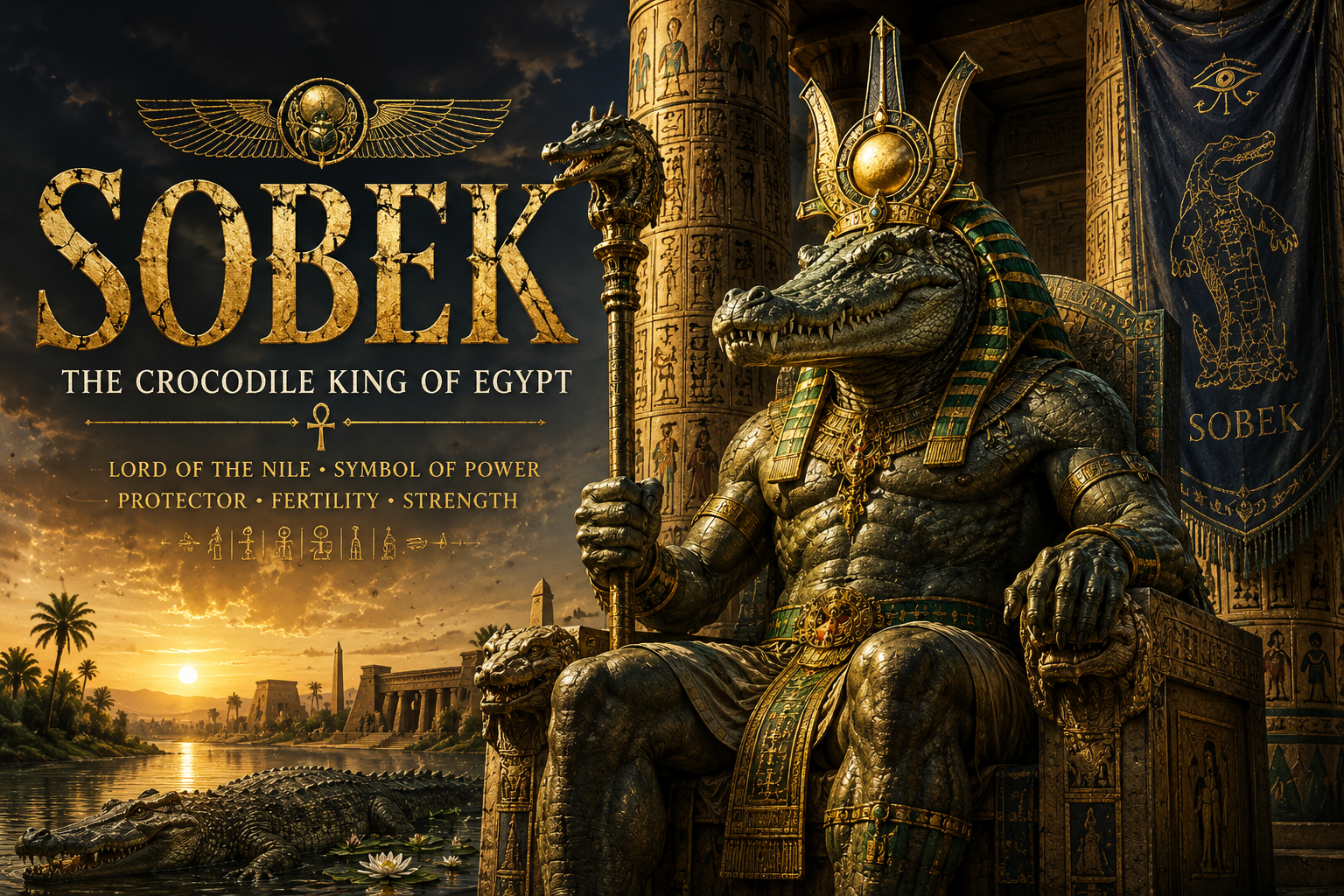
Often represented as a full crocodile or as a man with the head of a crocodile, Sobek became associated with royal authority, fertility, protection, military strength, and the Nile. His importance was so great that he was worshipped across Egypt for thousands of years, with major centers including the Fayum and Kom Ombo.
But was Sobek actually a “Crocodile King”?
Not literally in the sense of being an Egyptian pharaoh. Rather, the title captures the unusual relationship between Sobek, crocodiles, divine authority, and Egyptian kingship.
Who Was Sobek?
Sobek was one of ancient Egypt’s principal crocodile deities.
His name is associated with the crocodile, and his imagery reflected the animal’s physical power. He could appear as a crocodile or as a human figure with a crocodile’s head.
Ancient Egyptian religious traditions connected Sobek with water, wetlands, fertility, and the Nile. Because Egyptian agriculture depended heavily on the river’s annual flooding, these associations gave Sobek enormous importance.
The crocodile itself represented a fascinating contradiction.
It was dangerous enough to inspire fear, but it lived in the same river system that made Egyptian civilization possible.
Sobek therefore embodied both sides of nature:
Protection and danger.
Fertility and destruction.
Life and death.
Chaos and royal order.
The Metropolitan Museum of Art describes Sobek as an important Egyptian deity associated with the Nile floods and fertility, while also noting his connection to royal power.
Why Was Sobek Called a King?
Sobek was not an Egyptian king in the conventional historical sense.
However, his mythology and iconography were closely connected with royal authority.
One fascinating artifact in The Metropolitan Museum of Art is a New Kingdom scarab whose inscription refers to “King of Upper and Lower Egypt, Sobek Crocodile.” The object dates to the reign of Hatshepsut and Thutmose III, around 1479–1458 BCE.
Even more interestingly, crocodile imagery could itself carry royal associations.
A Late Period scarab featuring two crocodiles is connected with the concept of sovereignty. The Metropolitan Museum notes that the crocodile could represent both Sobek and the pharaoh, while two crocodiles appear in the hieroglyphic writing of the word for sovereign.
This helps explain why a modern title such as “Crocodile King of Egypt” feels appropriate when describing Sobek.
He was not a pharaoh.
He was something more mythological: a divine embodiment of crocodilian power and royal authority.
Sobek and the Nile
To understand Sobek, it is essential to understand the Nile.
Ancient Egypt depended on the river for agriculture, transportation, fishing, and everyday life.
The annual flooding of the Nile deposited fertile soil across agricultural land. Water therefore represented survival.
Sobek’s association with the river made him a powerful fertility deity.
The Egyptians could look at the crocodile and see a creature that belonged completely to the river environment.
It was powerful.
It was difficult to control.
And it commanded respect.
The Met notes that Sobek was associated with the Nile’s productivity and fertility, while crocodile amulets could portray him as a benevolent water deity.
The Dangerous Side of Sobek
Sobek was not simply a peaceful god of fertility.
The Nile crocodile was an apex predator, and the ancient Egyptians knew exactly how dangerous it could be.
The British Museum describes the crocodile as a large, dangerous, unpredictable predator that inhabited Egyptian riverbanks and marshes. Sobek consequently inherited some of the animal’s threatening characteristics. One of his epithets was “Sharp of Teeth.”
This dual nature made Sobek particularly interesting.
The same creature could represent:
fertility because of the Nile,
while also representing
death because of the crocodile.
In ancient Egyptian religion, these contradictions were not necessarily problems. Gods could possess multiple powers and aspects simultaneously.
Sobek’s strength came partly from this ability to embody nature in all its complexity.
Sobek and Egyptian Kingship
Sobek’s connection with kingship became particularly important during Egypt’s Middle Kingdom and later periods.
His association with royal authority was strengthened by his connection to powerful solar deities.
Eventually, Sobek was combined with Ra, the great Egyptian sun god, producing the composite deity Sobek-Ra.
This combination joined crocodilian strength with solar power.
The result was a deity associated with both the dangerous physical world and the cosmic authority of the sun.
By the Ptolemaic period, Sobek could be combined with or identified alongside other major deities, reflecting the increasingly complex religious landscape of ancient Egypt.
Sobek at Kom Ombo
One of the most famous places associated with Sobek is Kom Ombo in Upper Egypt.
The temple complex there was dedicated partly to Sobek and partly to the falcon god Haroeris, a form of Horus.
This pairing is visually fascinating.
One side represented the crocodile.
The other represented the falcon.
The temple therefore brought together two powerful animal symbols associated with different aspects of Egyptian religion.
The surviving temple is largely Ptolemaic in date, although the religious importance of the site extends beyond that period. Archaeological and museum evidence also shows that Sobek was actively worshipped at Kom Ombo and that sacred crocodiles were kept there.
The Sacred Crocodiles
Perhaps the most remarkable part of Sobek’s worship was the treatment of real crocodiles as sacred animals.
At temples dedicated to Sobek, crocodiles could be kept in captivity and treated as manifestations of the deity.
When sacred crocodiles died, some were carefully mummified.
The British Museum records a remarkable crocodile mummy associated with Sobek from Kom Ombo. The animal was nearly four metres long and had more than 25 mummified crocodile hatchlings attached to its back.
The Metropolitan Museum also preserves crocodile mummies and objects associated with the practice.
This was part of a much larger Egyptian tradition of animal cults, in which particular animals could serve as earthly manifestations of gods and be mummified after death.
Why Were Crocodiles Mummified?
Mummification was closely connected with the Egyptian belief in continued existence after death.
Sacred animals could therefore receive elaborate treatment after death.
Some crocodile mummies were decorated or provided with masks and other objects.
The Metropolitan Museum notes that crocodiles were mummified and offered to Sobek, particularly during the Late Period and Ptolemaic Period.
These objects demonstrate that Sobek’s worship was not merely symbolic.
The crocodile was physically present within the religious life of Egyptian temples.
Sobek’s Appearance
Sobek’s appearance was deliberately intimidating.
He could be represented as a complete crocodile or as a human body with a crocodile’s head.
In some representations, he wears elaborate divine headdresses incorporating solar and royal symbolism.
A New Kingdom depiction of Sobek held by The Metropolitan Museum shows him wearing a tall, plumed headdress decorated with a solar disk and ram horns. He also carries the ankh, a symbol associated with life, and the was scepter, a symbol of authority.
These details transformed the ordinary crocodile into something much greater.
It was no longer simply an animal.
It was a divine ruler of the waters.
Sobek and Fertility
It may seem strange that a predator could represent fertility.
But ancient Egyptian religion often connected apparently opposite forces.
The crocodile lived in the Nile.
The Nile created fertile agricultural land.
Therefore, the crocodile could become associated with the river’s life-giving power.
Sobek’s fertility symbolism extended to reproduction and renewal.
This made him more than a god of dangerous animals. He became part of the larger Egyptian understanding of how life emerges from the waters.
Sobek and Protection
Powerful animals often became protective symbols in Egyptian religion.
A crocodile’s strength could be frightening, but that same strength could be directed toward protecting those under divine care.
Sobek could therefore function as a protective deity.
His image could communicate:
Strength.
Authority.
Protection.
Fertility.
Power over dangerous forces.
This is one reason crocodile imagery remained important throughout Egyptian history.
Sobek and Medicine
Sobek also developed associations beyond water and fertility.
Ancient sources connect him with medicine and healing, particularly in later interpretations of the deity.
This may seem surprising until we consider the broader Egyptian religious worldview.
The same god could possess destructive and healing characteristics.
Life and death were not completely separate concepts.
A deity capable of controlling dangerous natural forces could also be understood as capable of protecting humans from them.
The Meaning of Sobek Today
Today, Sobek remains one of the most visually recognizable gods of ancient Egypt.
The crocodile-headed figure immediately communicates power.
His crown and divine symbols suggest authority.
His crocodile form suggests danger.
His connection with the Nile suggests life and fertility.
This combination makes Sobek particularly attractive to modern artists, designers, historians, filmmakers, and mythology enthusiasts.
A modern Crocodile King design inspired by Sobek can therefore represent:
Ancient power.
Royal authority.
Fearlessness.
Protection.
Strength.
The duality of life and death.
Sobek Was More Than a Crocodile God
Calling Sobek simply “the crocodile god” is accurate, but incomplete.
He represented a complicated collection of ideas that were fundamental to ancient Egyptian civilization.
He embodied the dangerous power of the Nile.
He represented fertility and abundance.
He was associated with royal authority.
He could be connected with solar power through Sobek-Ra.
He could protect and destroy.
And through sacred crocodiles and their mummification, his worship extended into the physical world.
That complexity is what makes Sobek so fascinating.
Final Thoughts
The Crocodile King of Ancient Egypt was not a historical pharaoh sitting on a human throne.
He was Sobek, a powerful crocodile deity whose influence reached into the Nile, fertility, protection, royal authority, and Egyptian religious life.
The ancient Egyptians looked at one of the Nile’s most dangerous creatures and saw something greater than a predator.
They saw power.
They saw fertility.
They saw danger.
They saw protection.
And ultimately, they saw a force worthy of worship.
Sobek’s legacy survives in temple reliefs, crocodile statues, amulets, inscriptions, and mummified crocodiles preserved thousands of years after their creation.
The image of the crowned crocodile remains powerful because its symbolism is timeless:
Respect the force you cannot control.
Fear the predator, but understand its power.
And remember that in ancient Egypt, even the most dangerous creature could become a king among the gods.