Table of Contents
Few figures in Mesoamerican mythology are as recognizable, mysterious, and enduring as Quetzalcoatl.
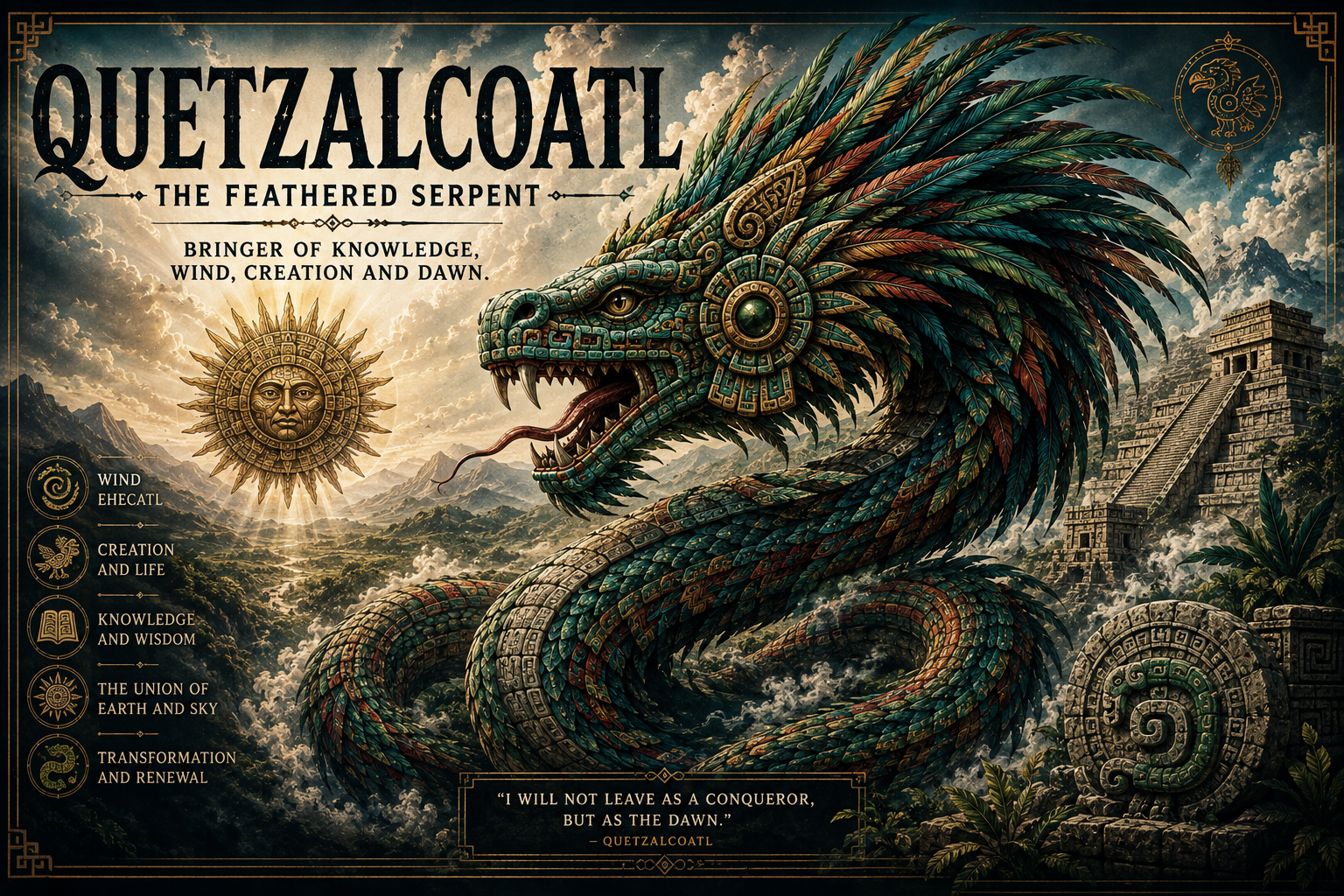
Known as the Feathered Serpent, Quetzalcoatl combines two powerful symbols: the serpent, associated with the earth and transformation, and the quetzal bird, associated with the sky, beauty, and freedom.
Together, they create an extraordinary image of a being that exists between earth and heaven.
But Quetzalcoatl is much more than a legendary serpent.
Across different Mesoamerican traditions, Quetzalcoatl was associated with wind, learning, creation, priesthood, civilization, and the movement between different realms of existence. His mythology changed across centuries and cultures, making him one of the most fascinating figures in ancient American history.
For modern art and fashion, Quetzalcoatl offers something particularly powerful: an ancient symbol that combines mythology, nature, spirituality, knowledge, and transformation into one unforgettable visual identity.
Who Was Quetzalcoatl?
Quetzalcoatl is the Nahuatl name commonly translated as “Feathered Serpent.”
The name comes from two elements:
Quetzal — referring to the brilliant quetzal bird.
Coatl — meaning serpent.
The combination creates the image of a serpent covered with or associated with feathers.
Quetzalcoatl was especially important in the religious traditions of Central Mexico, including those associated with the Toltecs and later the Mexica, commonly known as the Aztecs.
However, the concept of a feathered serpent is much older than the Mexica Empire.
Related feathered-serpent traditions existed throughout Mesoamerica, demonstrating how powerful this symbol became across different civilizations.
The Feathered Serpent Symbol
The most recognizable representation of Quetzalcoatl is the feathered serpent.
At first, the combination may seem contradictory.
A serpent moves along the ground.
A bird moves through the sky.
One represents the earth.
The other represents the heavens.
Quetzalcoatl brings these two worlds together.
This duality is one of the reasons the Feathered Serpent remains such a compelling symbol.
It represents the connection between seemingly opposite forces:
- Earth and sky
- Physical and spiritual
- Knowledge and mystery
- Life and transformation
- Nature and civilization
- Human existence and the divine
The symbolism is not simply about a powerful creature.
It is about connection.
Quetzalcoatl and Creation
Quetzalcoatl appears in several Mesoamerican creation traditions.
In some Nahua traditions, he plays an important role in the creation or restoration of humanity.
One famous tradition describes Quetzalcoatl traveling to the underworld to retrieve the bones of previous generations. These bones were then used in the creation of a new humanity.
The story gives Quetzalcoatl a role that goes beyond destruction and warfare.
He becomes associated with creation, sacrifice, renewal, and the continuation of life.
This creates an important contrast with the frightening appearance of the Feathered Serpent.
The creature may look dangerous.
Its mythology can represent creation.
Quetzalcoatl and the Fifth Sun
Mesoamerican traditions contain complex stories about different cosmic ages or “Suns.”
According to a prominent Nahua creation tradition, the present world is associated with the Fifth Sun.
The previous worlds were destroyed through different cosmic catastrophes.
Quetzalcoatl plays an important role in the restoration of humanity during the transition into the present age.
This connects him with one of the most powerful themes in mythology:
The world can end, but creation can begin again.
That idea of destruction followed by renewal makes Quetzalcoatl particularly relevant to modern interpretations of transformation.
Quetzalcoatl as a God of Wind
Quetzalcoatl was also closely connected with Ehecatl, the wind aspect of Quetzalcoatl.
Wind is invisible, yet its effects can be seen everywhere.
It moves clouds.
It carries seeds.
It changes landscapes.
It brings storms and clears the air.
This made wind a natural symbol for movement and invisible power.
In his Ehecatl aspect, Quetzalcoatl was associated with the forces that move between earth and sky.
This adds another dimension to the Feathered Serpent’s symbolism.
He was not simply a creature of the earth.
He represented movement between realms.
Quetzalcoatl and Knowledge
One of the most fascinating aspects of Quetzalcoatl is his association with knowledge and civilization.
Traditions surrounding Quetzalcoatl connect him with learning, priesthood, arts, calendar knowledge, and civilized life.
This makes the Feathered Serpent unusual compared with many mythological figures whose primary identities revolve around warfare.
Quetzalcoatl can represent a different kind of power.
The power of knowledge.
Strength can conquer an enemy.
Knowledge can transform an entire civilization.
This makes Quetzalcoatl an especially relevant symbol for modern audiences who value intelligence, creativity, curiosity, and self-development.
Quetzalcoatl and the Toltecs
Quetzalcoatl was strongly associated with the ancient city of Tula, which became an important center of Toltec culture.
The Toltecs flourished in central Mexico centuries before the rise of the Mexica Empire.
Later Mesoamerican traditions remembered the Toltecs as an important civilization associated with art, craftsmanship, knowledge, and cultural achievement.
Quetzalcoatl became deeply connected with this cultural memory.
His importance therefore extended beyond religion.
He became part of a larger story about civilization and cultural identity.
The Historical Figure Topiltzin Quetzalcoatl
One of the most interesting complications in Quetzalcoatl’s history is the existence of Topiltzin Quetzalcoatl, a legendary or semi-historical ruler-priest associated with Tula.
Over time, stories about the deity Quetzalcoatl and traditions concerning Topiltzin Quetzalcoatl became intertwined.
This has created considerable confusion in popular culture.
The Feathered Serpent deity and the legendary ruler are not simply the same historical person.
Instead, different traditions gradually connected divine mythology with stories about rulers and religious figures.
This is an important reminder that mythology is not static.
Stories evolve.
Different generations reinterpret them.
Quetzalcoatl and the Mexica
By the time of the Mexica Empire, Quetzalcoatl had become part of a much broader religious and political world.
The Mexica incorporated numerous older Mesoamerican traditions into their own religious system.
Quetzalcoatl was therefore not an isolated “Aztec god.”
His roots extend much further back into Mesoamerican history.
This distinction matters because the Feathered Serpent was a cultural tradition shared and transformed by multiple civilizations.
The Serpent as a Symbol of Transformation
The serpent has appeared as a powerful symbol in cultures around the world.
One reason is its ability to shed its skin.
The serpent appears to leave its old form behind and emerge renewed.
This makes it a natural symbol of:
- Transformation
- Renewal
- Rebirth
- Change
- Hidden knowledge
- Survival
When combined with the feathers of a bird, the symbolism becomes even more powerful.
The Feathered Serpent can be interpreted as a creature capable of crossing boundaries between different states of existence.
Earth becomes sky.
Death becomes renewal.
Ignorance becomes knowledge.
The ordinary becomes divine.
Why Quetzalcoatl Still Captivates Modern Audiences
Ancient mythology continues to influence modern movies, games, tattoos, graphic design, fashion, and popular culture.
Quetzalcoatl is particularly suitable for visual storytelling because his basic form is instantly recognizable.
A massive serpent covered in feathers creates a dramatic silhouette.
But the visual appeal is only part of the reason.
The mythology behind the image gives it depth.
A Quetzalcoatl design can represent:
Power
Transformation
Knowledge
Creation
Nature
Freedom
Mystery
Spiritual connection
This allows artists to create designs that feel both ancient and contemporary.
Quetzalcoatl in Modern Gothic Art
Although Quetzalcoatl originates in Mesoamerican traditions rather than European Gothic culture, the figure can work effectively within darker contemporary aesthetics.
A stylized Feathered Serpent can be surrounded by:
- Ancient architectural elements
- Celestial symbols
- Geometric patterns
- Feathers
- Skulls
- Flames
- Sun and moon imagery
- Stone textures
- Botanical elements
- Weathered engraving effects
The result can create an atmosphere that feels archaeological, mystical, and powerful.
However, respectful design matters.
Quetzalcoatl should not be reduced to a generic “monster” simply because the serpent form looks intimidating.
The mythology behind the figure is what makes the symbol meaningful.
Quetzalcoatl Tattoo Meaning
A Quetzalcoatl tattoo can carry many different interpretations.
For some people, it represents transformation.
For others, it represents knowledge and personal growth.
The Feathered Serpent can also symbolize the ability to overcome limitations and move between different stages of life.
Common modern interpretations include:
- Transformation
- Rebirth
- Wisdom
- Knowledge
- Strength
- Freedom
- Creation
- Spiritual growth
- Connection with nature
- Personal evolution
The meaning ultimately depends on the individual and the specific imagery used.
Quetzalcoatl and the Idea of Duality
Perhaps the strongest concept within the Feathered Serpent is duality.
Quetzalcoatl combines a creature of the ground with a creature of the sky.
That creates a visual representation of opposing forces existing together.
This idea is highly relevant to modern life.
We can be strong and vulnerable.
Confident and uncertain.
Connected to tradition while still seeking something new.
Grounded while dreaming of something greater.
Quetzalcoatl represents that tension.
He does not require one side to destroy the other.
He combines them.
The Feathered Serpent as a Symbol of Evolution
The most compelling modern interpretation of Quetzalcoatl may be evolution.
Not evolution in the strictly biological sense, but personal evolution.
The idea that a person does not have to remain the same forever.
You can learn.
You can change.
You can leave behind old limitations.
You can become something different.
The serpent provides the symbolism of transformation.
The feathers provide the symbolism of elevation.
Together:
Transform below. Rise above.
Why TOHOOD Draws From Quetzalcoatl
At TOHOOD, ancient mythology becomes a source of contemporary visual storytelling.
Quetzalcoatl is particularly powerful because his imagery combines an unmistakable silhouette with a deep symbolic history.
The Feathered Serpent can be interpreted as a symbol of transformation, knowledge, creation, freedom, and the connection between opposing worlds.
That makes it more than an ancient figure.
It becomes a statement.
A reminder that identity is not fixed.
You can shed an old version of yourself.
You can learn from the past.
You can rise beyond your limitations.
And you can carry ancient stories into a completely new era.
Final Thought
Quetzalcoatl has survived for centuries because the Feathered Serpent represents ideas that remain relevant.
We still seek knowledge.
We still experience transformation.
We still struggle between opposing forces.
We still look toward the sky for meaning.
And we still tell stories about becoming something greater than we were before.
Quetzalcoatl brings earth and sky together in one extraordinary symbol.
The serpent teaches transformation. The feathers teach elevation. Together, they represent the power to change and rise.
TOHOOD
Wear the story.