
Table of Contents
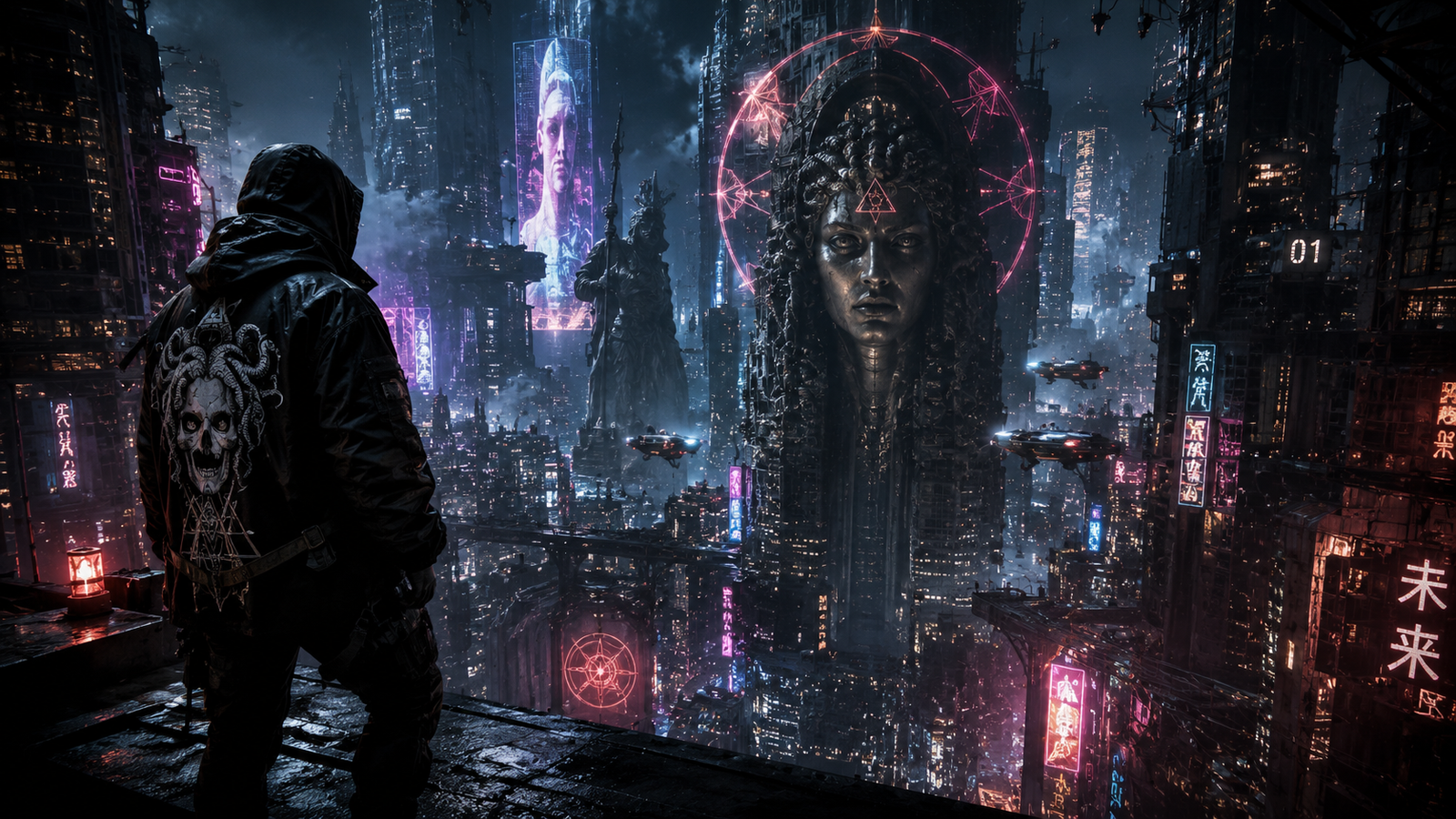
Neon reflected on wet concrete.
Towering cities disappearing into smog.
Human bodies altered by technology.
Corporations more powerful than governments.
People surviving beneath enormous digital systems they barely control.
That is the world cyberpunk taught us to imagine.
But cyberpunk is more than neon lights, futuristic jackets and glowing city streets. Beneath its instantly recognizable visual language is a much darker question:
What happens when technology advances faster than society can control it?
Cyberpunk has spent decades exploring that tension.
It imagines futures where artificial intelligence, surveillance, biotechnology, cybernetics and enormous corporations have transformed civilization—but have not necessarily made human life better.
That contradiction produced one of modern culture’s most recognizable aesthetics.
And today, cyberpunk has moved far beyond science-fiction novels. Its influence can be found in cinema, video games, graphic design, architecture concepts, music, streetwear and fashion.
To understand the cyberpunk aesthetic, however, we first need to understand the philosophy underneath it.
What Does Cyberpunk Mean?
The word cyberpunk combines two ideas:
Cyber — computers, networks, cybernetics and advanced technology.
Punk — rebellion, anti-authoritarianism, outsiders and resistance to established systems.
Put them together and the fundamental tension becomes clear.
Cyberpunk isn’t simply:
technology + cool clothes.
It is closer to:
advanced technology + people living at the edges of the system.
That distinction matters.
A futuristic city isn’t automatically cyberpunk.
A robot isn’t automatically cyberpunk.
Neon lighting isn’t automatically cyberpunk.
Cyberpunk emerges when technology, power and human experience collide.
High Tech, Low Life
One phrase captures cyberpunk remarkably well:
High tech. Low life.
The phrase describes the central contradiction of many cyberpunk worlds.
Technology may be extraordinarily advanced.
People may have:
- artificial limbs
- neural interfaces
- powerful computers
- artificial intelligence
- virtual worlds
- genetic engineering
- advanced surveillance
- enormous automated cities
Yet ordinary life can remain unequal, violent and precarious.
Technology improves.
Human society doesn’t necessarily improve with it.
That is the tension at the heart of cyberpunk.
Where Did Cyberpunk Come From?
Cyberpunk emerged from twentieth-century science fiction, particularly during the late 1970s and 1980s.
Earlier science fiction often imagined technological progress through rockets, space exploration and distant civilizations.
Cyberpunk turned the camera around.
Instead of asking:
What will humanity discover in space?
it increasingly asked:
What will technology do to everyday human life?
Writers explored computer networks, artificial intelligence, corporations, biotechnology and increasingly blurred boundaries between human beings and machines.
The term itself became associated with a new movement in science fiction during the 1980s.
William Gibson and Neuromancer
One of the most influential works in cyberpunk history is William Gibson’s 1984 novel Neuromancer.
The novel helped establish many concepts that later became fundamental to cyberpunk culture:
- cyberspace
- hackers
- artificial intelligence
- powerful corporations
- virtual environments
- technological body modification
- criminal undergrounds
- dense futuristic cities
Gibson’s imagined digital networks appeared before the modern internet became part of ordinary daily life.
That is one reason Neuromancer remains so influential.
It didn’t simply predict specific technologies.
It imagined how humans might live psychologically and socially inside digital systems.
Cyberpunk and Blade Runner
Cinema gave cyberpunk another enormously influential visual language.
Ridley Scott’s Blade Runner (1982), inspired by Philip K. Dick’s Do Androids Dream of Electric Sheep?, presented a future Los Angeles filled with:
- enormous advertising
- rain
- darkness
- dense urban architecture
- artificial humans
- corporate power
- multilingual streets
- technological decay
The result became one of the defining visual references for futuristic dystopian design.
The city looks technologically advanced.
But it doesn’t look clean.
It looks lived in.
Overcrowded.
Unequal.
Industrial.
That distinction became fundamental to the cyberpunk aesthetic.
What Does the Cyberpunk Aesthetic Look Like?
Cyberpunk design frequently combines futuristic technology with urban decay.
Common visual characteristics include:
- dark environments
- artificial lighting
- neon
- dense cityscapes
- industrial architecture
- holographic interfaces
- cables
- machinery
- masks
- technical typography
- cybernetic bodies
- surveillance equipment
- glitch effects
- layered graphics
- warning symbols
- distorted imagery
But simply combining these elements doesn’t automatically create meaningful cyberpunk design.
The strongest cyberpunk visuals communicate a world.
You should feel that something happened before the image.
And something is about to happen after it.
Why Neon Became Associated With Cyberpunk
Neon is probably the most recognizable feature of modern cyberpunk imagery.
Bright artificial light against darkness creates extreme visual contrast.
It also represents something deeper.
Cyberpunk cities are frequently dominated by artificial environments.
Natural light becomes scarce.
Instead, people live beneath:
- advertisements
- screens
- signs
- holograms
- corporate branding
The city itself becomes an interface.
Every surface communicates.
Every wall sells.
Every screen watches.
Neon therefore isn’t merely decoration.
It becomes part of the technological environment surrounding the individual.
Cyberpunk and the Megacity
Cyberpunk rarely imagines quiet futuristic villages.
It prefers enormous cities.
The cyberpunk megacity is typically:
vertical
crowded
technological
commercial
unequal
Power exists physically above the street.
Corporate towers rise into the skyline.
Ordinary people survive underneath.
That vertical separation frequently mirrors social hierarchy.
The architecture becomes part of the storytelling.
Technology Doesn’t Automatically Mean Progress
This may be the single most important idea in cyberpunk.
Modern societies often treat technological advancement as synonymous with progress.
Cyberpunk challenges that assumption.
Imagine a society with extraordinary artificial intelligence.
Now ask:
Who controls it?
Imagine perfect surveillance.
Ask:
Who is watching?
Imagine cybernetic body enhancements.
Ask:
Who can afford them?
Imagine enormous amounts of personal data.
Ask:
Who owns it?
Cyberpunk repeatedly takes technological optimism and introduces a second question:
Who benefits?
That is why the genre remains relevant.
Cyberpunk and Artificial Intelligence
Artificial intelligence appears throughout cyberpunk fiction.
But cyberpunk usually approaches AI differently from traditional robot stories.
The question isn’t merely:
Can a machine think?
The deeper questions are:
If a machine can think, does it have rights?
Can corporations own intelligence?
What happens when an AI becomes more capable than the people controlling it?
Where does human consciousness end?
Can identity exist without a biological body?
These questions have become considerably less abstract as real AI systems have entered everyday life.
Cyberpunk feels powerful today partly because questions that once belonged almost exclusively to speculative fiction increasingly resemble real technological debates.
Cyberpunk and Surveillance
Another recurring cyberpunk theme is surveillance.
Advanced cities contain:
- cameras
- databases
- biometric systems
- corporate networks
- tracking devices
- facial recognition
- interconnected infrastructure
Technology makes society more connected.
But connectivity can also make individuals more observable.
Cyberpunk asks what privacy means when nearly everything leaves a digital trace.
That tension between convenience and control remains one of the genre’s most enduring themes.
Cyberpunk and Corporations
Governments are not always the dominant powers in cyberpunk worlds.
Corporations frequently become enormous political forces.
They may control:
- technology
- security
- healthcare
- infrastructure
- information
- employment
- artificial intelligence
- weapons
- entire urban districts
This creates another defining cyberpunk idea:
economic power becoming political power.
The corporation is no longer simply selling products.
It becomes part of the structure governing everyday life.
Cyberpunk and the Human Body
Cyberpunk repeatedly asks:
What counts as human?
If someone replaces an arm with a mechanical one, are they less human?
What if they replace both arms?
Their eyes?
Their nervous system?
Their memories?
Their consciousness?
At what point does technology stop being something humans use and become something humans are?
This philosophical question explains the prevalence of:
- cybernetic implants
- prosthetic limbs
- neural interfaces
- artificial organs
- body modification
in cyberpunk imagery.
The body becomes another technological frontier.
Cyberpunk Fashion
Eventually, cyberpunk moved from fictional worlds into real fashion.
Cyberpunk-inspired clothing often draws from several visual traditions simultaneously:
- technical clothing
- military garments
- industrial workwear
- streetwear
- motorcycle clothing
- rave culture
- utility garments
- futuristic design
- punk aesthetics
The result can include:
- oversized silhouettes
- technical fabrics
- cargo structures
- straps
- utility pockets
- layered garments
- graphic hoodies
- masks
- dark palettes
- reflective materials
- futuristic typography
But cyberpunk fashion doesn’t need to look like a costume.
That distinction is important.
Cyberpunk Streetwear vs Cyberpunk Costume
There is a difference between:
dressing like a fictional cyberpunk character
and
incorporating cyberpunk ideas into contemporary streetwear.
Costume attempts to recreate a fictional world.
Streetwear interprets it.
A cyberpunk-inspired hoodie, for example, can use:
- futuristic typography
- dystopian graphics
- symbolic imagery
- technical composition
without requiring someone to wear cybernetic goggles and twenty straps.
For TOHOOD, that distinction is central.
We aren’t designing costumes.
We’re translating visual worlds into wearable graphics.
The Punk in Cyberpunk
The second half of the word deserves more attention.
Punk.
Cyberpunk protagonists are rarely powerful political leaders.
They’re often:
- hackers
- mercenaries
- criminals
- outsiders
- rebels
- street-level survivors
- people resisting enormous systems
That perspective matters.
Cyberpunk looks at advanced civilization from below.
The skyscraper may belong to the corporation.
But the story happens in the alley beneath it.
Cyberpunk vs Futurism
Not all futurism is cyberpunk.
A futuristic world might be:
- clean
- peaceful
- sustainable
- technologically optimistic
Cyberpunk is usually darker.
Futurism asks:
What could tomorrow look like?
Cyberpunk often asks:
What could go wrong with tomorrow?
That difference gives cyberpunk its tension.
Cyberpunk vs Techwear
These terms are frequently confused.
Cyberpunk is primarily a cultural and fictional aesthetic.
Techwear is a fashion approach emphasizing functionality, technical materials, weather resistance, mobility and utility.
They overlap visually.
But they aren’t identical.
A waterproof technical jacket can be techwear without having anything to do with cyberpunk.
Likewise, a cyberpunk graphic T-shirt may have no technical functionality whatsoever.
Cyberpunk vs Gothic Fashion
Cyberpunk and Gothic fashion also overlap.
Both frequently use:
- darkness
- dramatic imagery
- unconventional aesthetics
- rebellion
- subcultural identity
But their source material differs.
Gothic visual culture draws heavily from:
- historical architecture
- death symbolism
- Romanticism
- religious imagery
- darkness
- supernatural themes
Cyberpunk draws more strongly from:
- technology
- dystopia
- artificial intelligence
- digital culture
- corporations
- futuristic cities
TOHOOD sits in an interesting space where these worlds can meet.
When Ancient Myth Meets Cyberpunk
At first glance, mythology and cyberpunk seem like opposites.
Mythology looks backward.
Cyberpunk looks forward.
One imagines gods.
The other imagines machines.
One comes from ancient oral and religious traditions.
The other emerges from technological modernity.
But underneath, they ask surprisingly similar questions.
Who controls power?
What happens when humans exceed their limits?
What makes someone human?
Can power corrupt its owner?
What happens when we create something stronger than ourselves?
Ancient mythology explored these questions through gods and monsters.
Cyberpunk explores them through corporations, machines and artificial intelligence.
The visual language changes.
The questions remain.
From Mythology to Cyber Myth
This intersection is what we think of as Cyber Myth.
Imagine ancient archetypes translated into a technological future.
The warrior becomes the augmented mercenary.
The oracle becomes artificial intelligence.
The divine eye becomes surveillance.
The underworld becomes cyberspace.
The monster becomes an engineered organism.
The thunderbolt becomes electricity moving through a machine.
The mythology hasn’t disappeared.
It has changed form.
The Story Behind TOHOOD’s Awaken Cyberpunk Hoodie
TOHOOD’s Awaken Cyberpunk Hoodie explores this intersection between futuristic imagery and symbolic storytelling.
The design is built around the idea of awakening.
That word can mean several things.
Awakening to technology.
Awakening to reality.
Awakening to control.
Awakening to the systems surrounding us.
Or simply becoming conscious of something previously unseen.
The interpretation belongs to the wearer.
That’s intentional.
A strong graphic shouldn’t explain everything.
It should leave enough ambiguity for someone to create their own relationship with it.
Why Cyberpunk Works on Clothing
Cyberpunk is naturally suited to graphic fashion because the aesthetic already depends heavily on visual communication.
Cyberpunk worlds are filled with:
- logos
- warnings
- advertisements
- symbols
- screens
- codes
- corporate identities
- technical diagrams
The environment is graphic.
Putting that language onto clothing therefore feels natural.
The garment becomes another interface.
What Does Cyberpunk Symbolize Today?
Depending on context, cyberpunk can represent:
- rebellion
- technological anxiety
- individuality
- resistance
- alienation
- digital identity
- anti-authoritarianism
- futurism
- human-machine integration
- surveillance
- corporate power
- dystopia
It can also simply function as a visual aesthetic.
Not everyone wearing cyberpunk-inspired clothing is making a political or philosophical statement.
Sometimes a design is attractive because it creates a compelling world.
Both interpretations can coexist.
Why Cyberpunk Still Feels Relevant
The most interesting thing about cyberpunk is that we haven’t stopped needing it.
Artificial intelligence is advancing.
Digital identities are becoming increasingly important.
Wearable technology continues developing.
Corporations hold enormous quantities of personal data.
Cities are becoming increasingly connected.
Virtual environments are becoming more sophisticated.
None of this means we are living inside a cyberpunk novel.
Reality is far more complicated.
But the questions cyberpunk asked decades ago have become harder to dismiss as distant fantasy.
That is why the aesthetic continues to evolve.
Cyberpunk isn’t merely nostalgia for an imagined future.
It is a visual language for thinking about the future we are actually building.
Frequently Asked Questions
What is the cyberpunk aesthetic?
The cyberpunk aesthetic combines advanced technology with dystopian or socially unequal environments. Common visual elements include dense futuristic cities, artificial lighting, cybernetics, industrial design, digital interfaces and rebellious street-level characters.
What does cyberpunk mean?
Cyberpunk combines technological concepts represented by “cyber” with the anti-establishment and outsider perspective associated with “punk.”
What is “high tech, low life”?
It summarizes a central cyberpunk contradiction: technology may become extremely advanced while ordinary human living conditions, inequality or political freedom do not necessarily improve.
Is cyberpunk a fashion style?
Cyberpunk began primarily as a science-fiction movement but has significantly influenced fashion, streetwear, costume design and visual culture.
What is the difference between cyberpunk and techwear?
Cyberpunk is primarily a fictional/cultural aesthetic, while techwear focuses on functional clothing, technical materials and utility. The two can overlap visually but aren’t interchangeable.
Is cyberpunk the same as futuristic fashion?
No. Futuristic fashion can be optimistic, minimalist or experimental. Cyberpunk typically introduces themes of dystopia, technological power, inequality or rebellion.
Why is cyberpunk usually dark?
Darkness, artificial lighting and dense urban environments reinforce cyberpunk’s themes of technological dominance, uncertainty and social tension. However, there is no rule requiring every cyberpunk design to use a dark palette.
What is Cyber Myth?
Cyber Myth is TOHOOD’s interpretation of the intersection between ancient archetypes and futuristic visual culture—taking recurring themes such as power, identity, transformation and rebellion and translating them into a technological design language.
Final Thought
Cyberpunk has never really been about predicting which gadgets we’ll own.
Its most important predictions are questions.
What happens when technology becomes inseparable from identity?
What happens when information becomes power?
What happens when corporations understand individuals better than individuals understand themselves?
What happens when humans begin redesigning the human body?
And what happens when technological progress doesn’t bring social progress with it?
Those questions explain why cyberpunk survives.
The neon lights are memorable.
The futuristic cities are beautiful.
The machines are fascinating.
But underneath everything is something deeply human:
the struggle to remain an individual inside systems larger than ourselves.
Ancient mythology told that struggle through gods.
Cyberpunk tells it through machines.
TOHOOD exists somewhere between them.
Ancient instinct. Future form.
Explore the TOHOOD Awaken Cyberpunk Hoodie
About TOHOOD Editorial
TOHOOD Editorial Team
TOHOOD Editorial explores mythology, ancient cultures, symbolism, art, speculative culture and their influence on contemporary visual design and fashion. Historical and cultural claims are distinguished from TOHOOD’s own creative interpretations so readers can tell documented context from brand storytelling.