Table of Contents
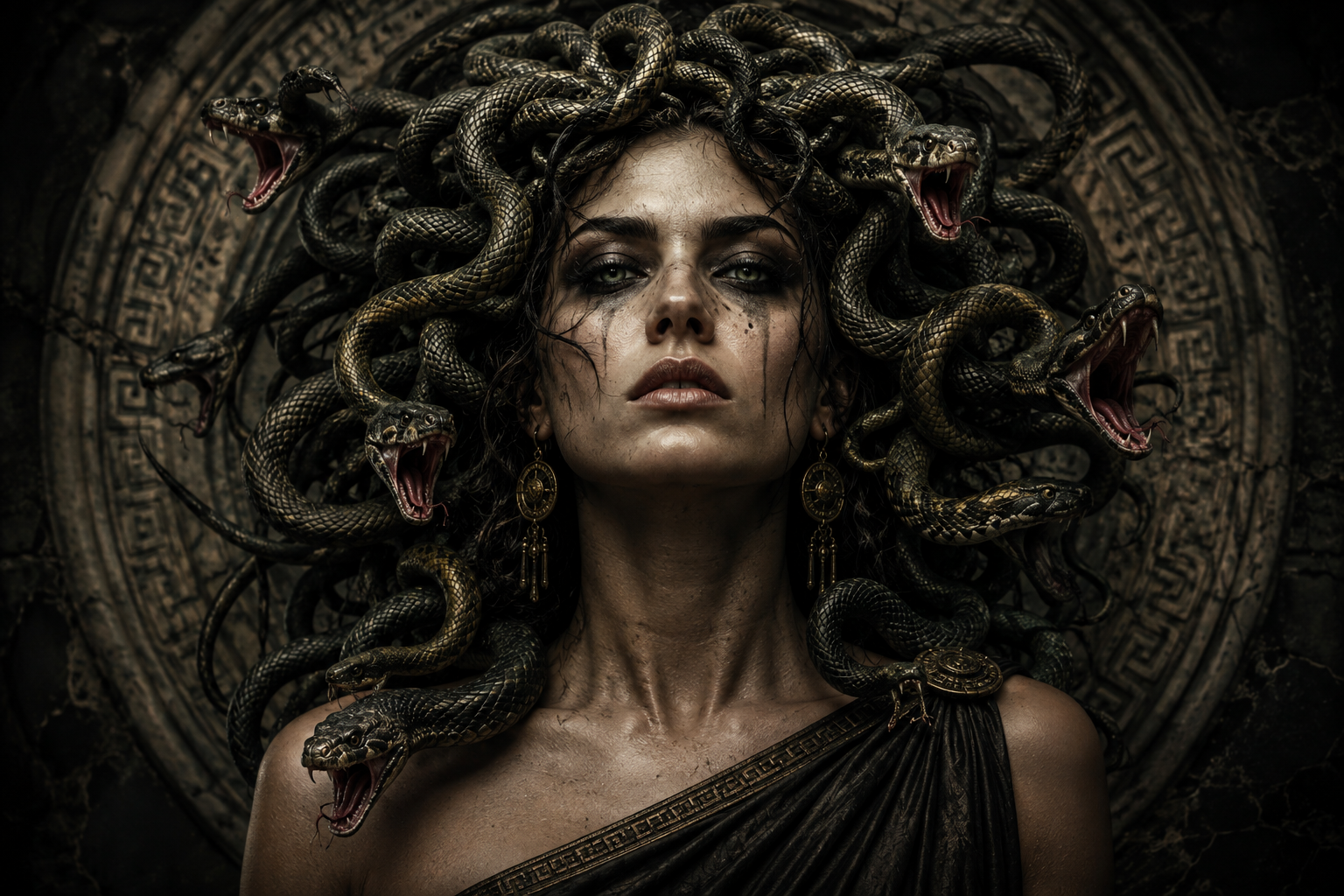
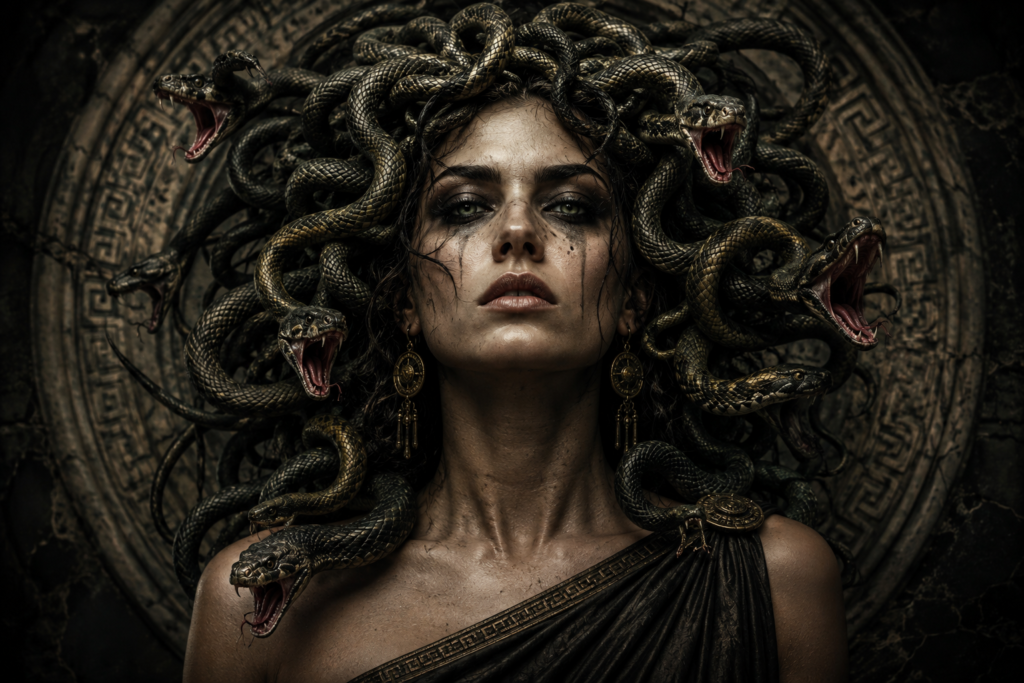
A woman with snakes for hair.
A gaze that could turn a person to stone.
A severed head carried by a hero.
Few figures from Greek mythology are as visually recognizable as Medusa. Yet the image most people know today represents only one part of a much older and more complicated tradition.
Medusa was one of the three Gorgons, monstrous figures whose terrifying appearance and petrifying gaze made them powerful symbols in ancient Greek art. Unlike her sisters Stheno and Euryale, Medusa was mortal. Her death at the hands of Perseus became one of the best-known episodes in Greek mythology, while her severed head—the gorgoneion—continued to appear in Greek and later Mediterranean art as an image capable of inspiring fear and protection at the same time.
But there is an important detail that is often lost in modern retellings:
There isn’t just one ancient Medusa story.
Different authors, periods and artistic traditions changed the character.
That distinction matters.
To understand Medusa, we have to look beyond the modern image of “the snake-haired woman” and examine how the myth developed, how ancient artists represented her, and why her image still has such extraordinary power today.
Who Was Medusa?
Medusa was one of the three Gorgon sisters in Greek mythology.
The other two were Stheno and Euryale.
According to Hesiod’s Theogony, the Gorgons were daughters of Phorcys and Ceto, ancient sea deities. Hesiod describes three sisters and specifically identifies Medusa as mortal while Stheno and Euryale were immortal.
This makes Medusa unusual.
She belongs to a family of supernatural beings, but she is not immortal.
Her mortality ultimately makes her vulnerable to Perseus.
The ancient tradition therefore gives us a much more specific picture than the simplified phrase “Medusa was a monster.”
She was:
- one of three Gorgons
- the only mortal Gorgon
- associated with a terrifying gaze
- represented with serpentine imagery
- ultimately killed by Perseus
- the mother, in myth, of Pegasus and Chrysaor
The British Museum similarly identifies Medusa as the most famous of the three Gorgons and notes that Pegasus and Chrysaor emerged at the moment of her death.
The Three Gorgons
Medusa did not exist alone.
Greek mythology traditionally describes three Gorgon sisters:
Medusa
The mortal sister and the one whose story became most famous.
Stheno
One of Medusa’s immortal sisters.
Euryale
The other immortal sister.
Ancient representations could depict Gorgons with combinations of features that seem strange to modern viewers: wings, serpent-like hair, tusks, exaggerated eyes, protruding tongues and other monstrous characteristics.
The exact appearance was not completely fixed.
Ancient artists interpreted the Gorgon in different ways.
That is important because the elegant, beautiful, snake-haired Medusa that dominates modern fantasy imagery is only one stage in a much longer visual history.
The Metropolitan Museum notes that earlier representations could show Medusa as a terrifying creature, while later fifth-century BCE art increasingly experimented with more humanized versions of her face.
Why Could Medusa Turn People to Stone?
The most famous feature of Medusa is her gaze.
Anyone who looked directly at the Gorgon could be turned to stone.
That supernatural ability creates the central problem of the Perseus story.
How do you kill something you cannot safely look at?
The solution is one of the cleverest elements of the myth.
Perseus does not simply attack Medusa face-to-face.
Instead, he uses a reflective shield to see her indirectly.
The Metropolitan Museum describes Perseus using the reflective surface of a bronze shield so that he could approach Medusa without meeting her petrifying gaze directly.
The idea is remarkably simple:
Do not fight the monster on its terms.
That makes the story more than a battle between hero and creature.
It is a story about strategy.
Perseus and Medusa
The story of Perseus and Medusa is one of the best-known monster-slaying narratives from Greek mythology.
Perseus was the son of Zeus and Danaë.
The king of Seriphos, Polydektes, eventually sent Perseus on what appeared to be an impossible mission:
Bring back the head of Medusa.
This was not a normal challenge.
Medusa was protected by her supernatural powers, and even looking at her could mean death.
Perseus therefore needed help.
In the most familiar version of the story, divine assistance comes from Athena, Hermes and the nymphs, who provide or help him obtain equipment necessary for the mission.
The Metropolitan Museum’s ancient Greek vase from around 500 BCE depicts Perseus fleeing with Medusa’s head while Pegasus emerges from her severed neck.
How Did Perseus Kill Medusa?
Perseus found the Gorgons while they were asleep.
Instead of looking directly at Medusa, he watched her reflection in a shield.
He then cut off her head.
The act sounds simple when summarized in one sentence, but the symbolism of the scene is much more interesting.
Perseus succeeds because he refuses to confront Medusa in the obvious way.
He uses distance.
Reflection.
Timing.
Tools.
Strategy.
Ancient Greek artists repeatedly returned to this moment.
The Metropolitan Museum holds a fifth-century BCE Attic vase showing Perseus beheading the sleeping Medusa, while another ancient vessel shows him escaping with her severed head.
The story became visual shorthand for heroic intelligence overcoming supernatural danger.
What Happened When Medusa Died?
Medusa’s death does not simply end the story.
According to ancient mythology, two extraordinary beings emerged from her body:
Pegasus, the famous winged horse,
and
Chrysaor, a figure associated with a golden sword.
Their father was Poseidon.
This detail appears in Hesiod’s Theogony and later mythological traditions.
The image is strange but important.
Medusa’s death produces new life and new mythological figures.
So even at the moment of destruction, the story is not simply about an ending.
It becomes another beginning.
Was Medusa Originally a Beautiful Woman?
This is where modern retellings often become misleading.
The familiar story says that Medusa was once a beautiful woman who was transformed into a monster after an encounter involving Poseidon and Athena.
That version is famous.
But it is not the earliest version of the myth.
The Met’s research on Medusa emphasizes that the tradition developed over time. Earlier Greek sources present Medusa as one of the Gorgons rather than necessarily beginning her story as an ordinary beautiful woman.
The later transformation story is especially associated with the Roman poet Ovid’s Metamorphoses.
This distinction is crucial.
When someone says:
“Medusa was a beautiful woman cursed by Athena.”
that describes one influential version of the story, not an uncontested description of the earliest Greek tradition.
Understanding that difference makes the mythology more interesting, not less.
The Ovid Version of Medusa
Ovid’s Metamorphoses, written centuries after the earliest Greek literary traditions, gives Medusa a different backstory.
In Ovid’s account, Medusa is described as originally beautiful. Her hair is singled out as especially beautiful before her transformation.
The story connects her with Poseidon and Athena’s temple, after which Athena transforms her hair into snakes.
This later version became enormously influential in European literature and art.
It also helped create the modern image of Medusa as a beautiful woman whose face is contrasted with the snakes surrounding her head.
But we should be careful about collapsing Ovid’s Roman-era version into all of Greek mythology.
Mythology evolved.
That evolution is part of Medusa’s story.
Athena and Medusa
Athena has an unusual relationship with Medusa.
In some traditions, Athena is connected to Medusa’s transformation.
But in the broader Perseus story, Athena also helps Perseus defeat her.
After Medusa’s death, her head becomes associated with Athena’s protective equipment.
This creates one of the most fascinating contradictions in the mythology:
Medusa is both a defeated monster and a protective symbol.
The very image that represents danger becomes a weapon against danger.
The Gorgoneion: Medusa’s Face as a Symbol
The severed head of Medusa is known as the gorgoneion when represented as an image.
Ancient Greek artists used Gorgon imagery in a wide range of contexts.
The face could appear on:
- shields
- armor
- pottery
- architectural decoration
- jewelry
- coins
- sculpture
- protective objects
The purpose was not simply decorative.
The terrifying face could function as a protective or apotropaic image—something intended to ward off danger.
The Metropolitan Museum explains that Medusa’s head became an important protective image and was used in connection with Athena’s armor.
The British Museum’s collection also contains ancient objects featuring Gorgoneia, demonstrating how widespread the motif became across the Mediterranean world.
This gives Medusa an unusual symbolic duality:
She frightens the viewer while protecting the person who displays her image.
Why Did Ancient Greeks Put Medusa on Shields?
At first, putting a terrifying face on a shield might seem strange.
But think about what a shield does.
A shield protects its owner.
The Gorgoneion adds another imagined layer of protection: an image so frightening that it could symbolically repel an enemy.
This is the logic of apotropaic imagery.
The image does not need to be beautiful.
It needs to be powerful.
It needs to communicate:
Stay away.
This helps explain why the Gorgon remained popular in ancient visual culture.






























Medusa’s Appearance in Ancient Art
The way Medusa looks has changed dramatically throughout history.
Early Gorgon images could be highly exaggerated.
Artists might give the figure:
- large staring eyes
- open mouths
- protruding tongues
- tusks
- snakes
- wings
- exaggerated facial features
These weren’t attempts at realistic portraiture.
They were designed to communicate supernatural terror.
By the Classical period, however, artists increasingly experimented with a more humanized Medusa.
The Metropolitan Museum specifically notes an important fifth-century BCE example in which Medusa is represented with the face of a beautiful young woman rather than the older monstrous type.
This transition is fascinating because it shows that the image of Medusa was never static.
Artists kept reinventing her.
Medusa and the Meaning of Beauty
The evolution from monstrous face to beautiful face creates an important visual tension.
What happens when something frightening is also beautiful?
That question has made Medusa particularly useful to later artists.
Her image can represent:
- beauty and danger
- attraction and fear
- vulnerability and power
- life and death
- transformation
- protection
- rebellion
These interpretations are modern extensions rather than universal ancient meanings.
That distinction matters.
We can interpret Medusa today without pretending that every modern interpretation was the original ancient meaning.
Is Medusa a Symbol of Feminine Power?
In contemporary culture, Medusa is frequently interpreted as a symbol of female power, resistance, survival and transformation.
There is a reason this interpretation has become so popular.
Her story involves a woman whose appearance becomes a source of supernatural power, whose image survives after her death, and whose severed head is ultimately used as a protective emblem.
But this should be understood as a modern interpretation, not simply presented as the single original meaning of Medusa.
Ancient Greeks did not necessarily understand Medusa through today’s categories of feminism, empowerment or identity politics.
Modern audiences bring their own questions to ancient stories.
That is not a flaw.
It is one reason myths continue to survive.
Why Medusa Still Matters
Medusa has something that many ancient mythological characters lack:
instant visual recognition.
You don’t need to explain a paragraph of mythology to recognize the combination of:
woman + snakes + intense gaze.
That’s incredibly powerful in visual culture.
The symbol works on a T-shirt.
It works on a sculpture.
It works on a tattoo.
It works on jewelry.
It works in fashion photography.
It works in film.
The image is immediately legible.
But the story underneath it gives the image depth.
Medusa in Renaissance and Later Art
Medusa’s influence did not disappear with antiquity.
Artists across Europe repeatedly returned to the Perseus story and the image of Medusa.
The Met’s collections include later representations of Medusa and Perseus, including works connected with Antonio Canova and other European artists.
The British Museum likewise holds works representing Perseus, Medusa and the Gorgon motif across different historical periods.
This continued artistic interest demonstrates something important:
Medusa isn’t merely an ancient character preserved in a book.
She became an artistic language.
Different generations have used her to explore fear, beauty, violence, power and transformation.
Medusa in Modern Fashion
Fashion depends heavily on visual symbolism.
A garment can communicate identity before the wearer says anything.
That makes mythology particularly useful.
Greek gods, ancient symbols, warriors and monsters can function as visual shorthand for ideas such as:
strength
mystery
rebellion
power
individuality
transformation
Medusa is especially strong because she combines beauty and danger.
She doesn’t fit neatly into the traditional category of either hero or villain.
She is a figure people can interpret.
And that makes her particularly suited to graphic fashion.
The Story Behind TOHOOD’s Medusa Design
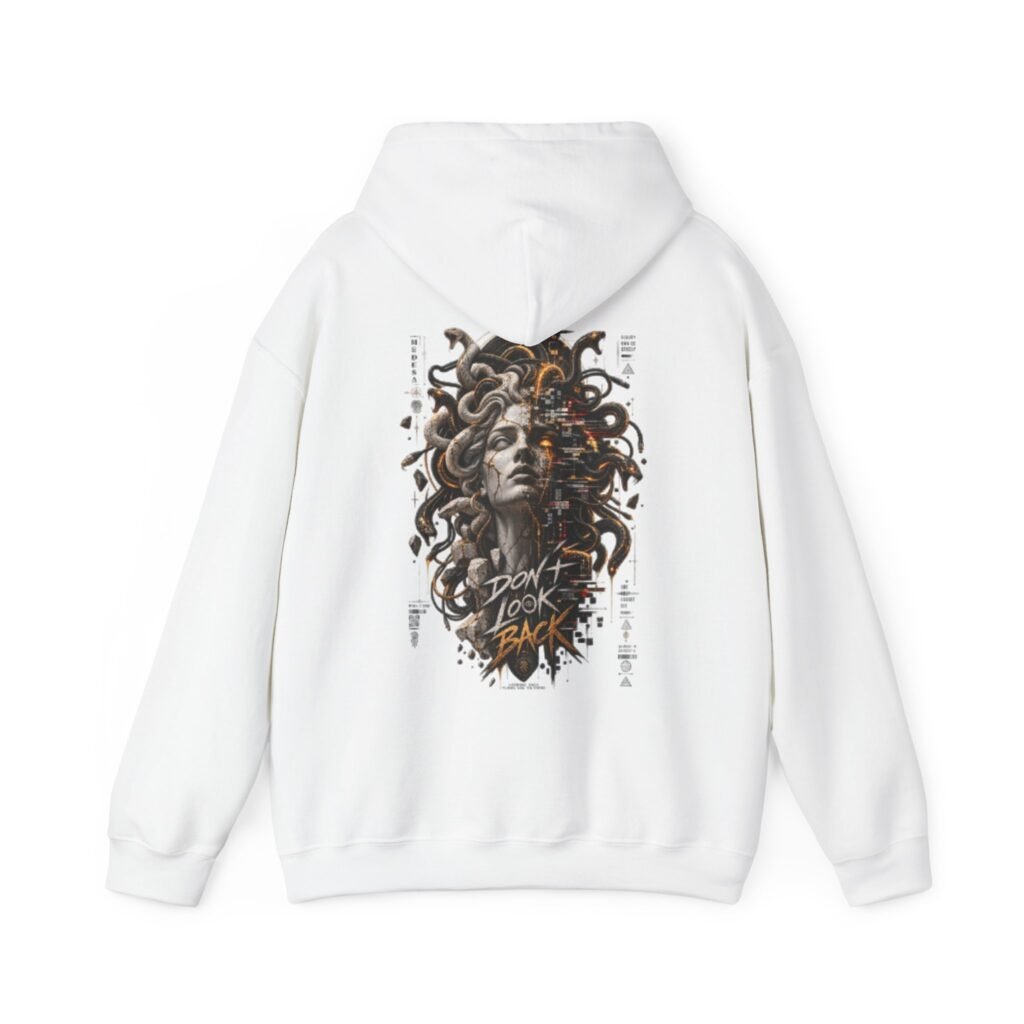
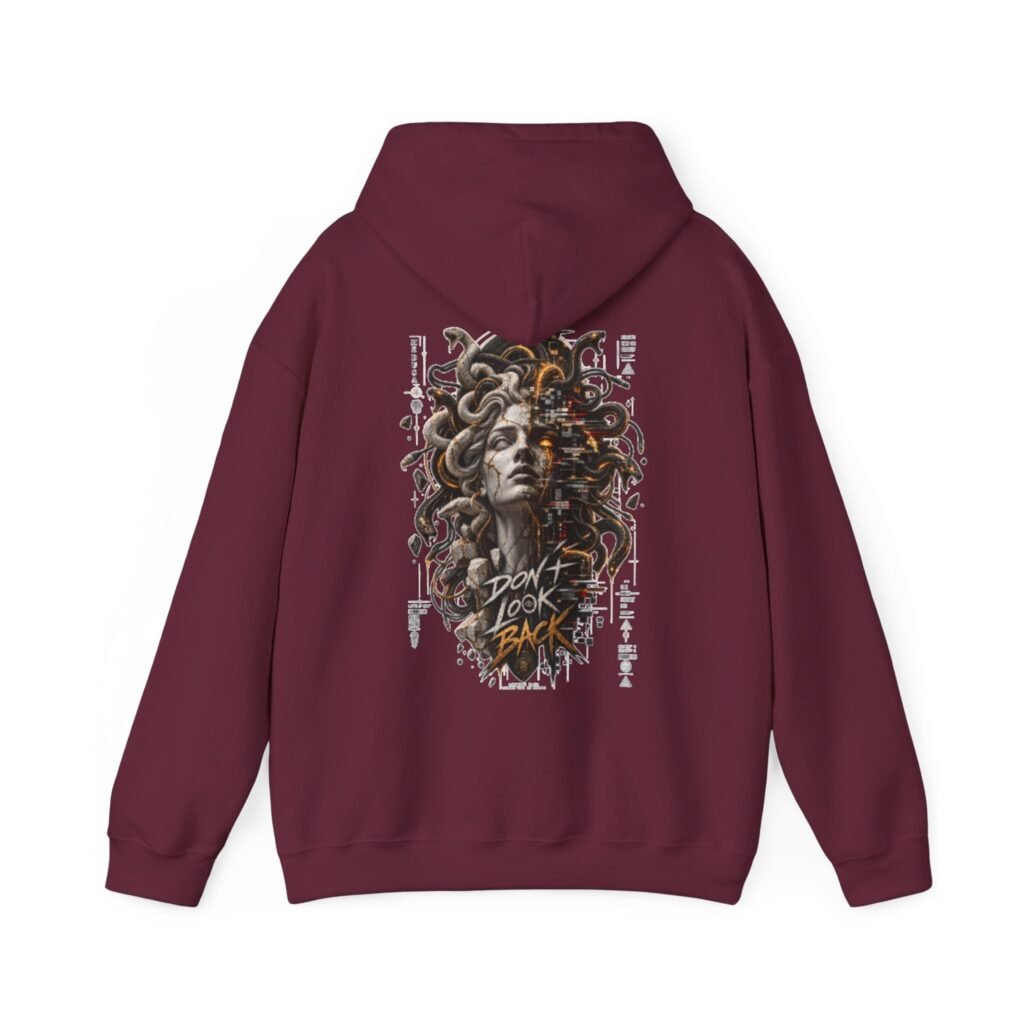
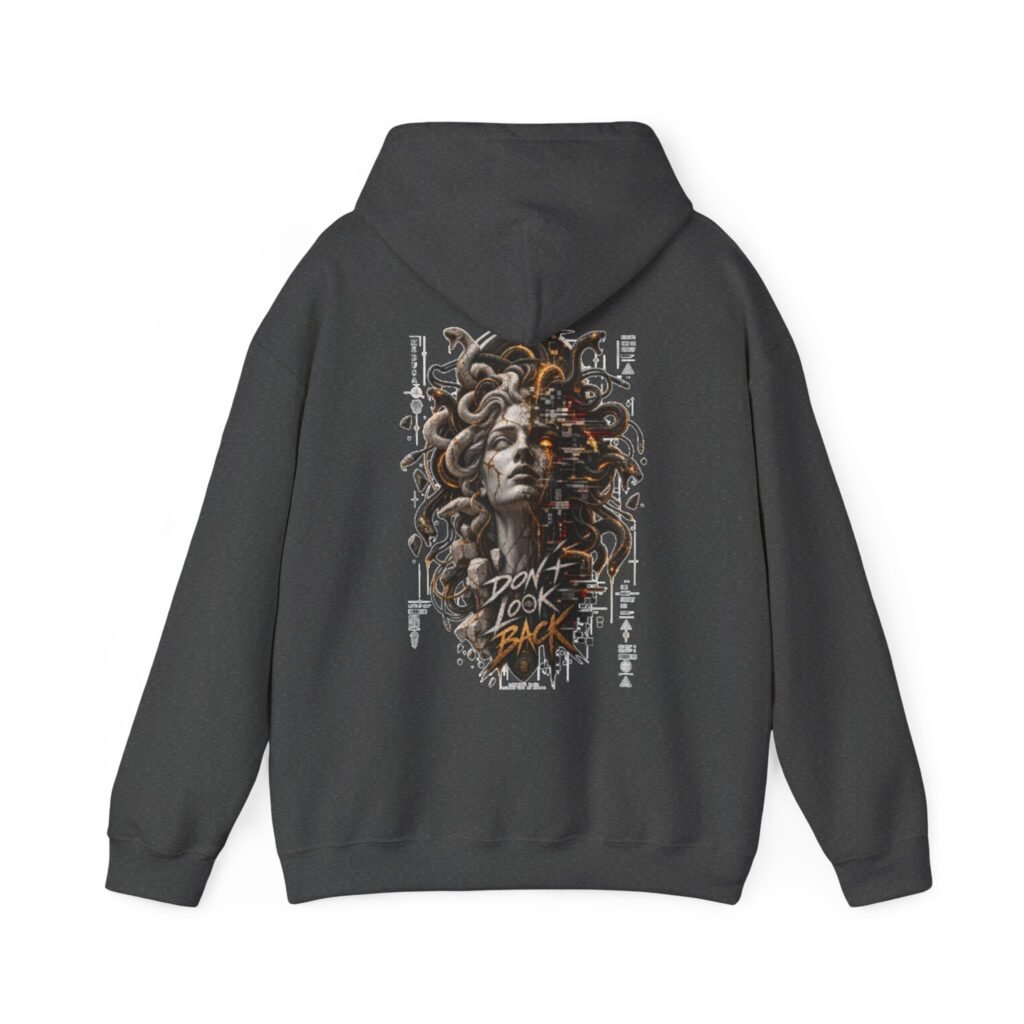
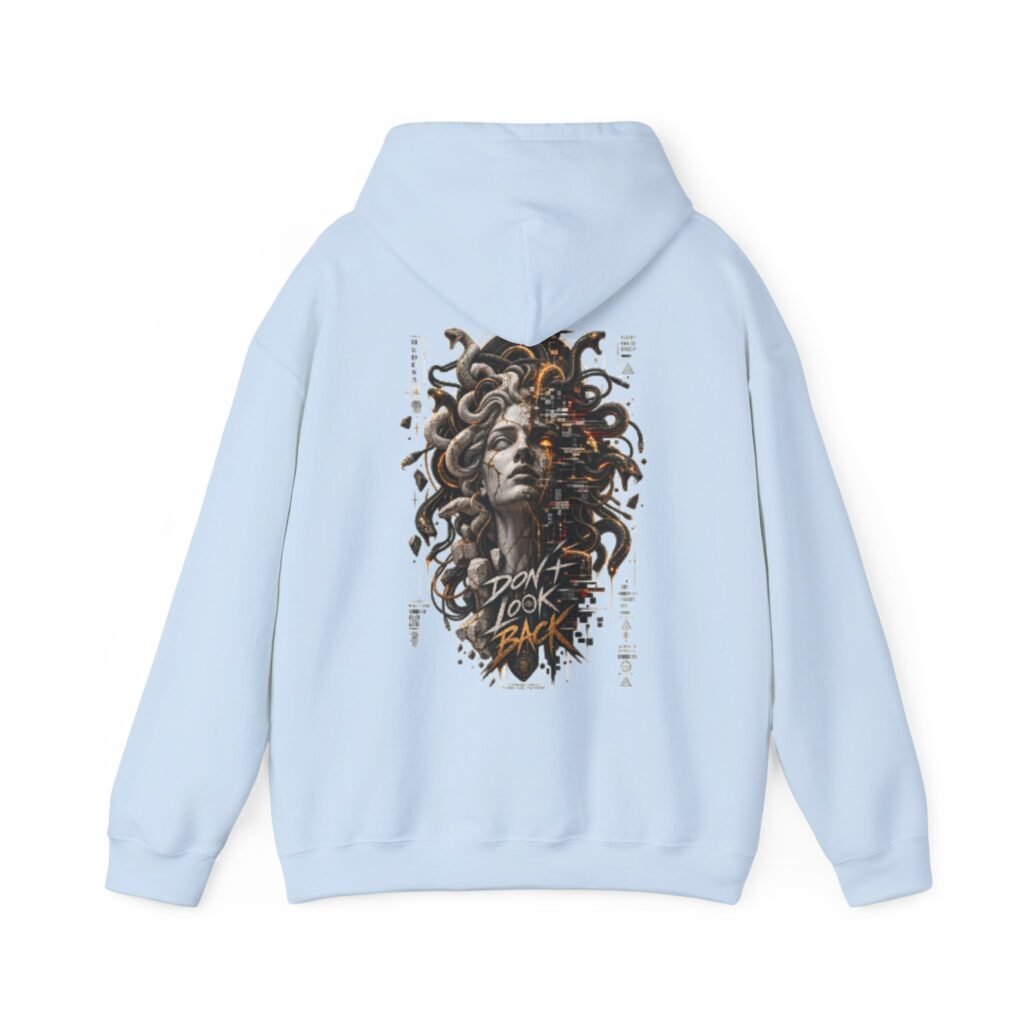
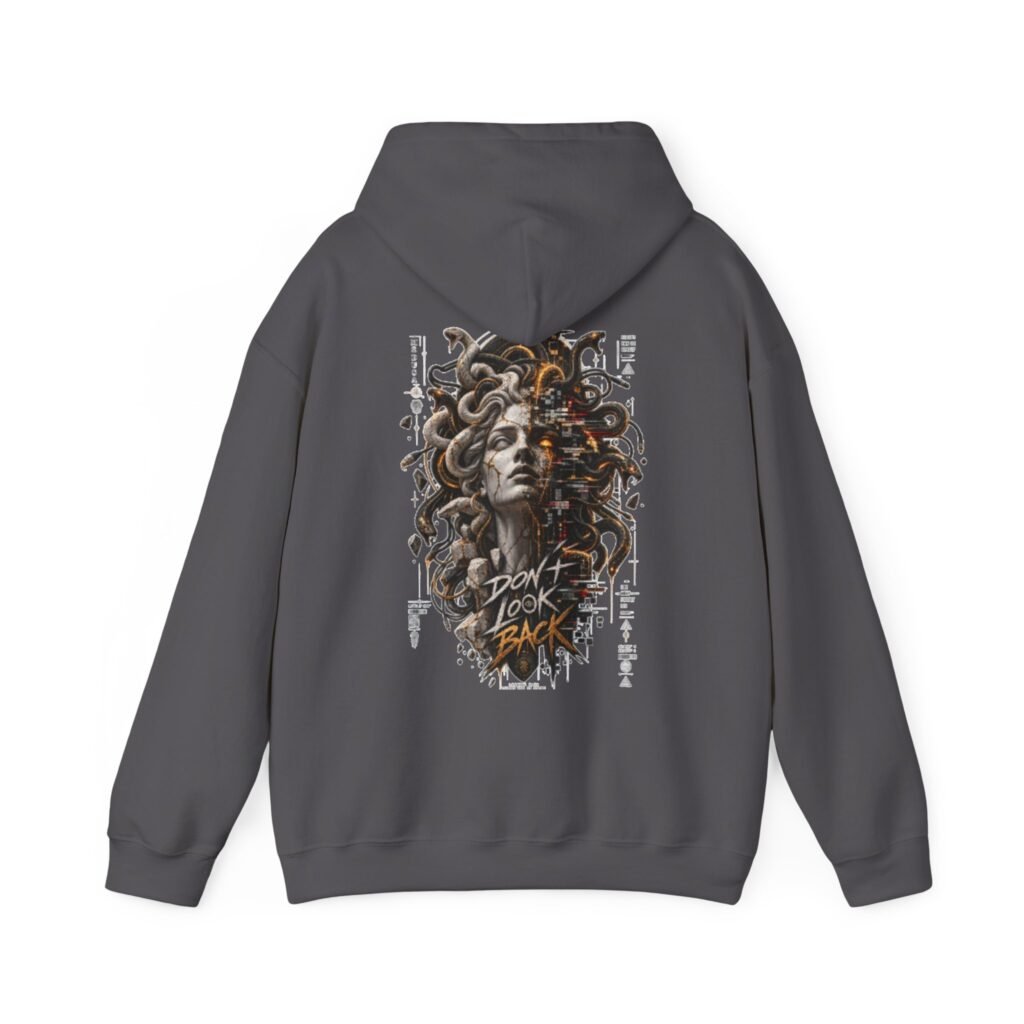
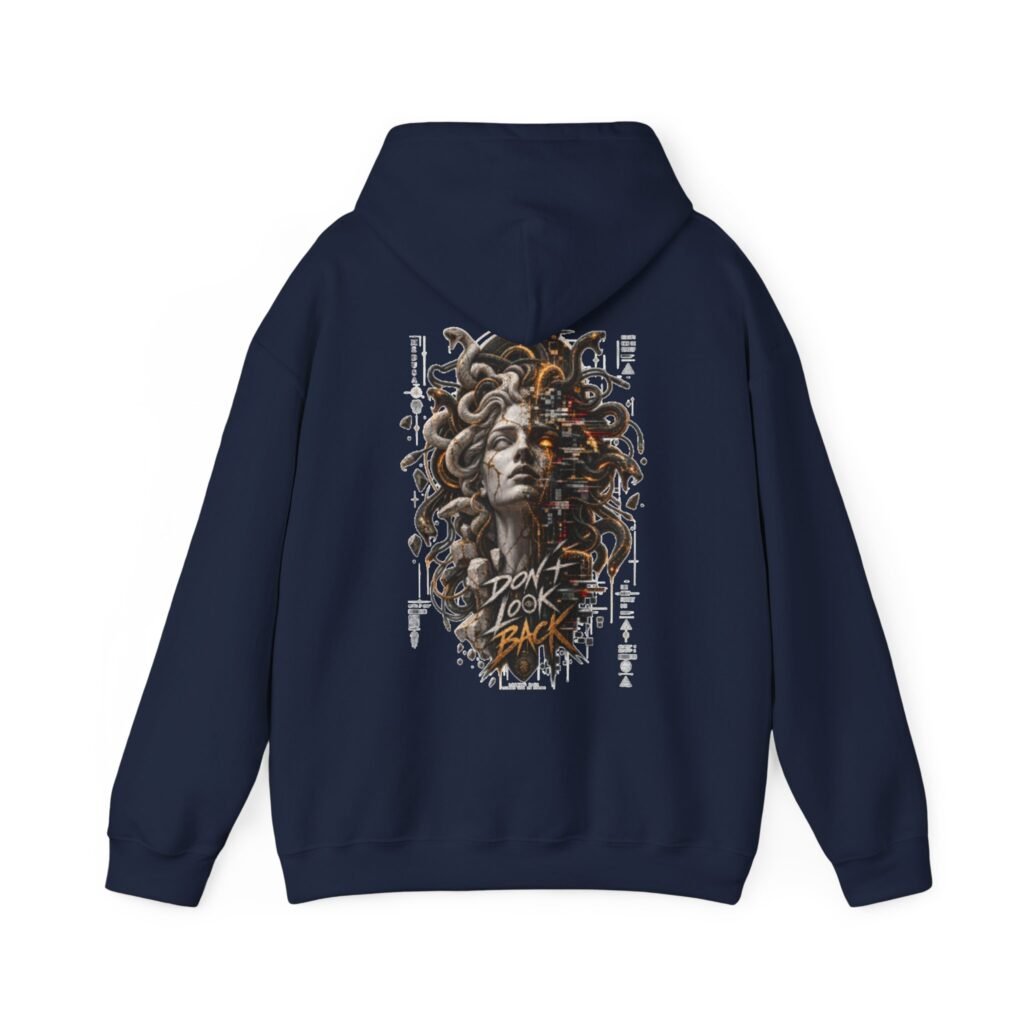
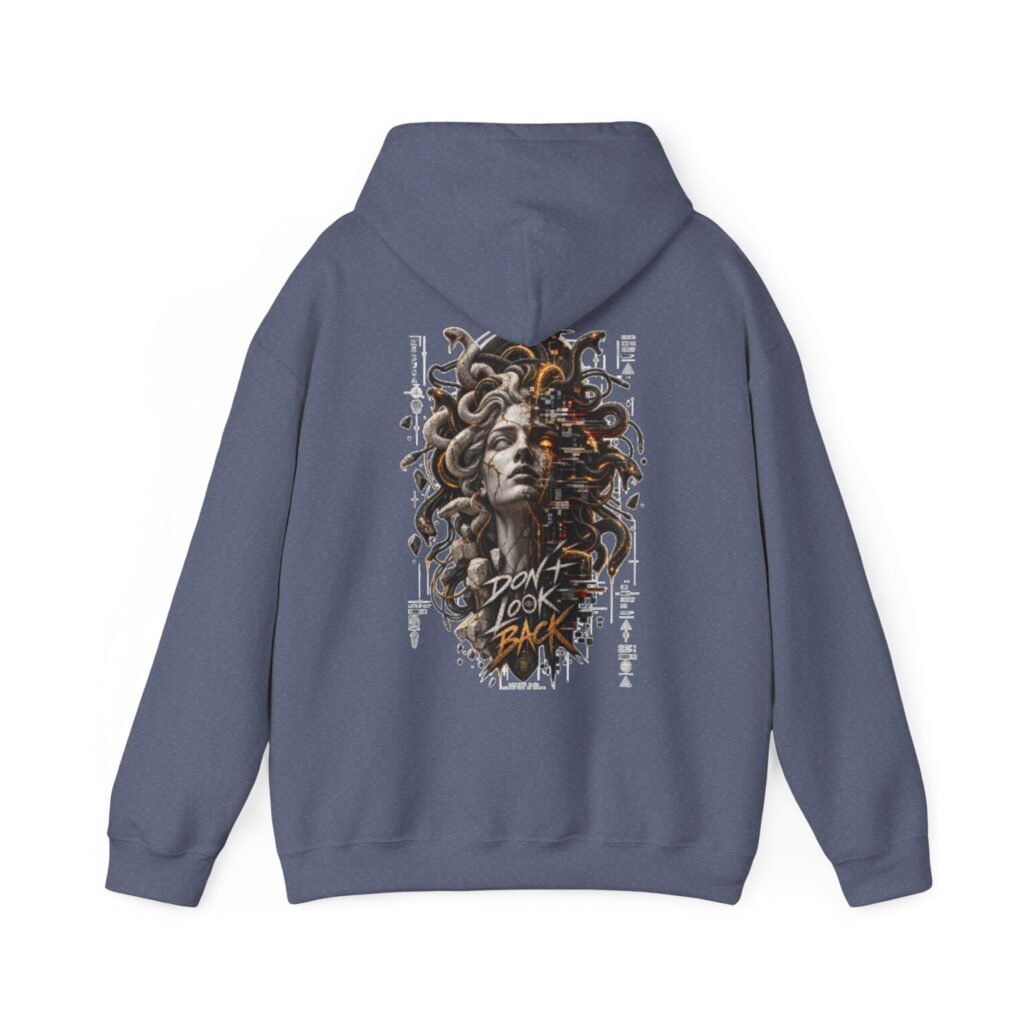
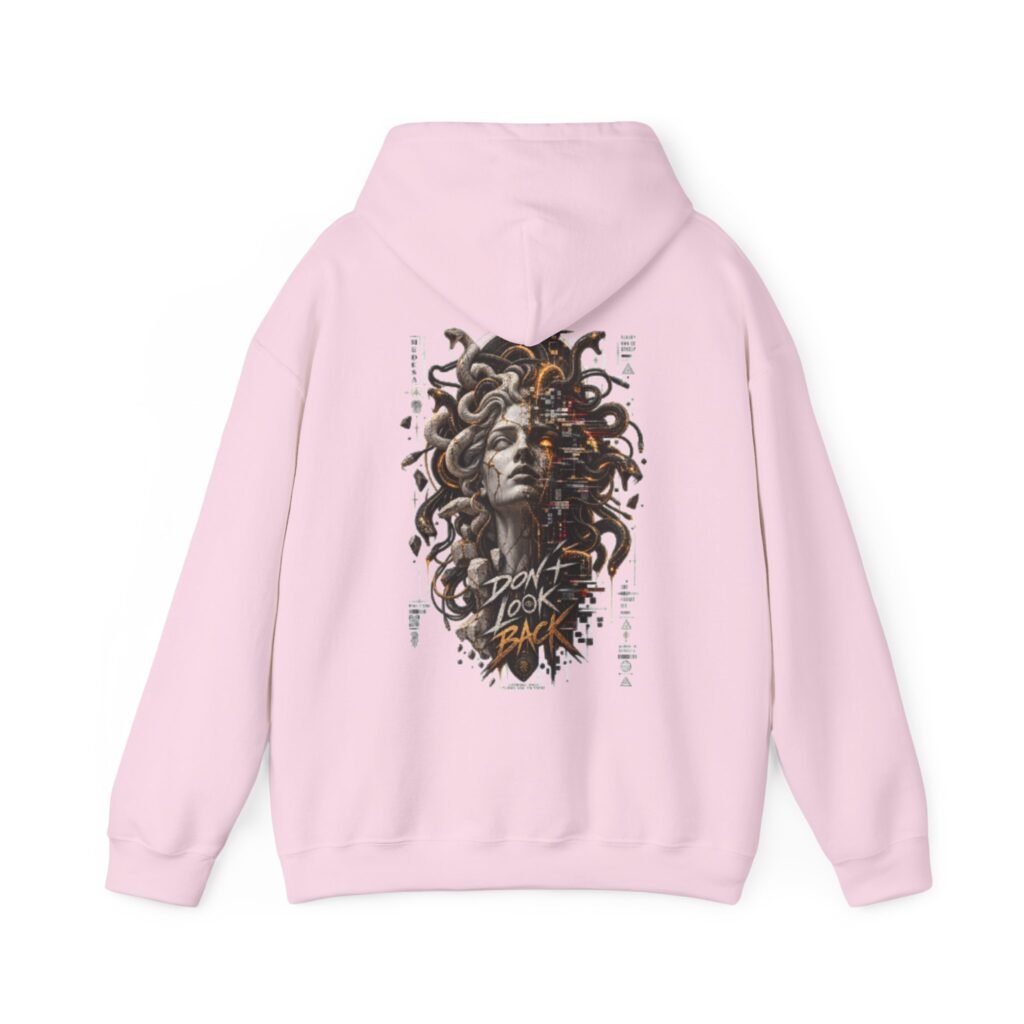
TOHOOD’s Medusa “Face the Curse” Hoodie draws from this visual tension.
The design isn’t intended to reproduce an ancient archaeological object.
Instead, it takes the recognizable mythology of Medusa and translates it into contemporary dark streetwear.
The phrase “Face the Curse” reinforces the central visual idea of confronting something feared rather than simply running from it.
That’s an interpretation.
The ancient myth provides the foundation.
Modern graphic design provides the visual language.
And the wearer brings their own meaning to the symbol.
What Does Medusa Symbolize?
There isn’t one universally correct modern meaning.
Depending on the context, Medusa can represent:
- transformation
- danger
- protection
- fear
- beauty
- mortality
- resilience
- power
- mystery
- rebellion
- the consequences of violence
- the tension between attraction and fear
The ancient Gorgon was terrifying.
The modern Medusa can be empowering.
The artistic Medusa can be beautiful.
The fashion Medusa can be rebellious.
The mythological Medusa can be all of these things at once.
That’s the strength of a symbol that has survived for thousands of years.
Medusa vs the Other Gorgons
A common question is why Medusa became much more famous than Stheno and Euryale.
The main reason is narrative.
Medusa is the mortal Gorgon.
That makes her the one Perseus can kill.
Her role in one of the most famous Greek heroic stories gave her a much larger cultural afterlife.
Her severed head also became a powerful symbol in ancient art.
As a result, the name “Medusa” eventually became far more recognizable than the names of her sisters.
What Happened to Medusa’s Head?
After Perseus killed Medusa, he carried her head with him.
The head retained its petrifying power.
This allowed Perseus to use it as a weapon during subsequent adventures.
Eventually, he gave the head to Athena.
Athena placed the Gorgon image on her protective equipment.
The Met describes the head as becoming part of Athena’s armor, while ancient sources also connect the Gorgoneion with her aegis and shield.
The transformation is remarkable:
Medusa the monster → Medusa’s head → protective symbol.
The same image changes meaning without losing its power.
Why the Medusa Myth Has Survived
The strongest myths usually contain more than one idea.
Medusa has:
- a monster
- a hero
- gods
- transformation
- beauty
- violence
- supernatural power
- death
- protection
- artistic symbolism
It is visually memorable and narratively flexible.
Every generation can find something different in it.
Ancient audiences could see a terrifying protective symbol.
Classical artists could experiment with beauty and monstrosity.
Renaissance artists could explore the drama of Perseus.
Modern audiences can interpret Medusa through identity, resilience and power.
The story survives because it can change without disappearing.
Frequently Asked Questions
Who was Medusa?
Medusa was one of three Gorgon sisters in Greek mythology and the only mortal one. She was eventually killed and beheaded by the hero Perseus.
Was Medusa originally a beautiful woman?
Not in the earliest surviving Greek literary tradition. Hesiod presents Medusa as one of the Gorgons. The influential story of Medusa originally being beautiful and later transformed is associated particularly with Ovid’s later Roman Metamorphoses.
Why did Medusa have snakes for hair?
Snake imagery became one of the defining characteristics of the Gorgon. In later versions of the story, Ovid connects Medusa’s transformation with her hair becoming snakes. Ancient Gorgon representations, however, already used serpentine imagery before Ovid.
Who killed Medusa?
The Greek hero Perseus killed Medusa by approaching her while she was asleep and using a reflective shield to avoid looking directly at her.
Could Medusa really turn people to stone?
Within the mythology, yes. Her gaze was described as capable of petrifying those who looked directly at her.
Who were Medusa’s sisters?
Her sisters were Stheno and Euryale. Unlike Medusa, both were traditionally immortal.
What came from Medusa after she was killed?
According to Greek mythology, Pegasus and Chrysaor emerged from her body after Perseus cut off her head.
What does Medusa symbolize?
In ancient contexts, the Gorgon image could function as a frightening protective symbol. Modern interpretations additionally associate Medusa with transformation, feminine power, resilience and rebellion. These modern meanings should not be confused with a single original ancient interpretation.
Why is Medusa used in fashion?
Medusa has an instantly recognizable visual identity and carries themes of danger, beauty, mystery, transformation and power, making the figure particularly effective for contemporary graphic design and fashion.
Final Thought
Medusa is often reduced to one sentence:
The woman with snakes for hair who turned people to stone.
But that description misses why the character has lasted.
Medusa is a story about fear.
It is a story about strategy.
It is a story about transformation.
It is a story about beauty becoming frightening and fear becoming protective.
Most importantly, it is a story that has never stopped changing.
Ancient Greek artists did not all portray Medusa in the same way. Later Roman writers changed parts of her story. Renaissance and modern artists reinvented her again.
And today, her image continues to move between mythology, art, popular culture and fashion.
That is the power of a symbol.
It survives because every generation finds a new way to look at it.
Face the myth. Wear the legend.
Explore the TOHOOD Medusa “Face the Curse” Hoodie
Sources & Further Reading
- Hesiod, Theogony
- Ovid, Metamorphoses
- Pseudo-Apollodorus, Bibliotheca
- The Metropolitan Museum of Art — Dangerous Beauty: Medusa in Classical Art
- The Metropolitan Museum of Art — Greek and Roman Art collection
- British Museum — Medusa and Gorgon collection records
- Theoi Project — Gorgons and Medusa reference material
The Metropolitan Museum’s research is particularly useful for understanding how Medusa’s representation changed from monstrous Gorgon imagery toward more humanized depictions in Classical Greek art.
About the Author
TOHOOD Editorial Team
TOHOOD Editorial explores mythology, ancient cultures, symbolism, art and their influence on contemporary visual culture and fashion. Our mythology articles distinguish surviving ancient traditions from later interpretations and modern cultural readings, using primary texts, museum collections and established reference material wherever possible.